
Access Grand Traverse County Deed Records
Grand Traverse County deed records are filed at the Register of Deeds office in Traverse City, where all property transfers, mortgages, liens, and land documents for the county are part of the permanent public record. The office maintains a computer image index going back to 1966, with documents available as far back as May 1946. Whether you need to search ownership history, check for encumbrances, or record a new deed, this office handles it all during regular business hours Monday through Friday.
Grand Traverse County Deed Records
Grand Traverse County Register of Deeds Office
The Register of Deeds office is at 400 Boardman Avenue, Suite 103, Traverse City, MI 49684. Office hours are Monday through Friday, 8:00 AM to 5:00 PM. The phone number is 231-922-4753 and the fax is 231-922-2770.
The office page on the county website is at co.grand-traverse.mi.us. The site includes contact information, links to recording forms, and details on available services. Grand Traverse County offers Property Fraud Alert and e-recording, making it one of the more accessible county register offices in northern Michigan.
The office records all instruments that affect real property in Grand Traverse County. This includes warranty deeds, quitclaim deeds, mortgages, land contracts, easements, and liens. Every recorded document becomes part of the permanent public record and can be searched by anyone.
The Grand Traverse County Register of Deeds Office page on the county website provides current fee schedules, staff contact information, and guidance for property owners and title professionals.
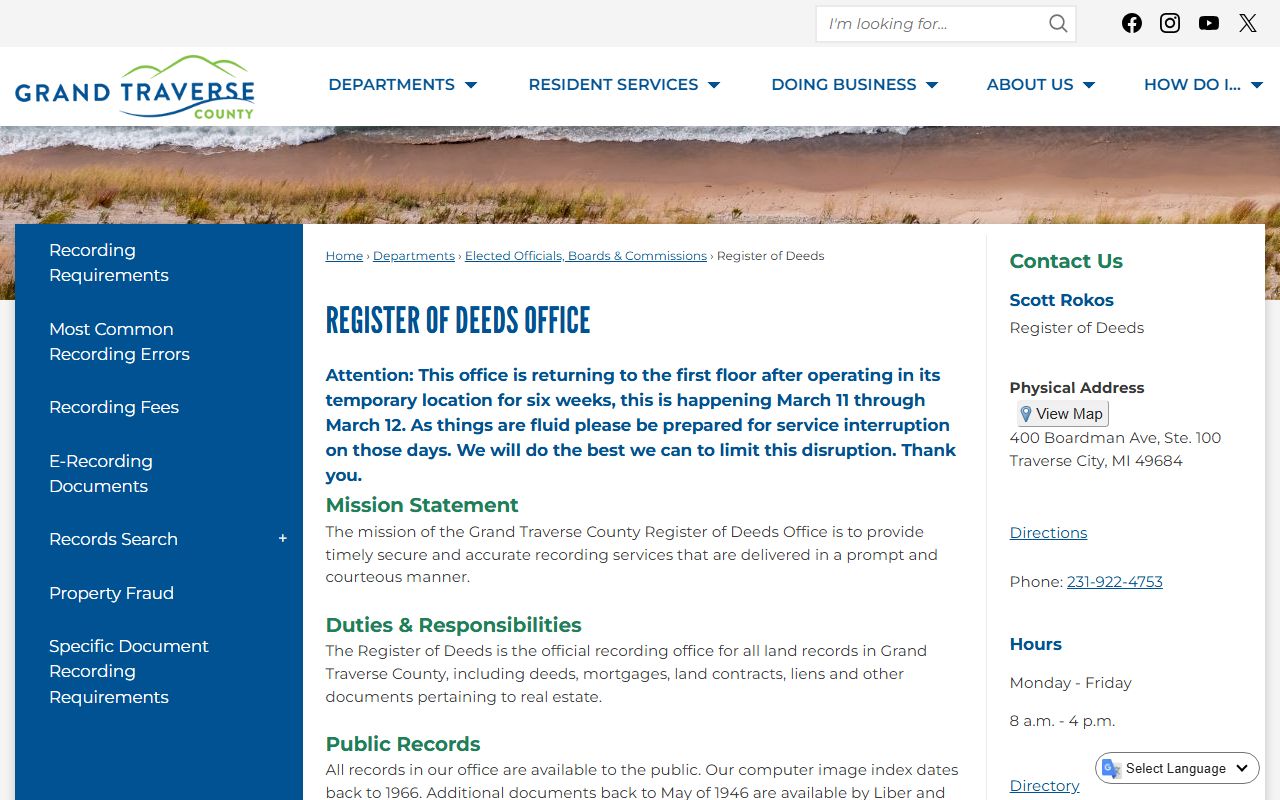
The office page also provides links to the online records search system and instructions for e-recording documents in Grand Traverse County.
Recording Fees in Grand Traverse County
The recording fee is $30 per document. This flat rate applies to all recorded instruments, including deeds, mortgages, and releases. Page count does not affect the fee. State law under MCL 600.2657 set this statewide amount, effective October 1, 2016.
Copies are $1.00 per page. Certified copies require an additional $5.00 certification fee. You can request copies in person at the office or by mail. For mail requests, include the liber and page number or grantor and grantee names and recording date, along with payment and a return envelope.
Call 231-922-4753 before sending a mail request to confirm the exact amount you need to include. Processing times can vary. The office staff can also help you determine the correct document details to include in your request.
Transfer Tax in Grand Traverse County
Michigan charges a two-part real estate transfer tax. The state levies $3.75 per $500 of value under MCL 207.521. Grand Traverse County adds $0.55 per $500 under MCL 207.501. The combined rate is $8.60 per $1,000 of the sale price.
Sellers typically pay the transfer tax at closing. A valuation affidavit must be filed with any deed that conveys property for value. This form states the sale price and is required for the Register of Deeds to accept the deed for recording. Without the affidavit, the document will be rejected.
Transfers between certain family members, transfers involving government agencies, and some other types of conveyances may qualify for a transfer tax exemption. If your transaction is exempt, mark the exemption on the deed and include the appropriate affidavit. A title professional or attorney can help confirm exemption eligibility before you record.
Document Formatting Requirements
All documents recorded in Grand Traverse County must meet the formatting standards set by MCL 565.201. The Register of Deeds will reject any document that does not comply with these rules.
The first page must have a 2.5-inch blank top margin reserved for recording information. All other margins must be at least 0.5 inches. Font size must be at least 10 points. The first page must identify the document type, names of all grantors and grantees, the complete legal description of the property, the mailing address for tax statements, and the preparer's name.
Submit documents that are ready to record. If the Register of Deeds returns your document for non-compliance, you will need to revise and resubmit. This adds time and cost. Check formatting requirements before the document is signed and notarized to avoid these delays.
The Grand Traverse County government website provides access to all county departments, including the Register of Deeds, Equalization, and the Treasurer's office, which handles property tax payments and delinquencies.

The county site connects property owners to the assessor, treasurer, and planning departments, all of which maintain records relevant to property ownership in Grand Traverse County.
E-Recording and Property Fraud Alert
Grand Traverse County accepts e-recorded documents through approved vendors. E-recording allows title companies, lenders, and attorneys to submit documents digitally rather than in person or by mail. The Michigan Uniform Real Property Electronic Recording Act, MCL 565.841, authorizes county registers of deeds to accept these electronic submissions.
Approved vendors include Simplifile (1-800-460-5657), ePN, CSC, and Indecomm. Set up an account with your preferred vendor before submitting documents. Each vendor charges its own service fee. Once enrolled, e-recording is typically the fastest way to get a document into the record, often within one business day.
The Property Fraud Alert service is free for all Grand Traverse County property owners. When you register, you get an email notification any time a document is recorded under your name. This early warning system helps you catch unauthorized deed filings before they create larger problems. Sign up through the county website or ask the Register of Deeds office for instructions.
Historical Records and Title Searches
Grand Traverse County's computer image index goes back to 1966. Document images are available as far back as May 1946. This depth of records is valuable for attorneys, title companies, and property researchers who need to trace ownership over many decades.
For older records, staff can assist with searches using the original ledger books or microfilm archives. Contact the office in advance if you need records that predate the computer system. Staff can advise you on how to access older materials and whether copies are available.
Title searches in Grand Traverse County typically cover at least 40 years of ownership history to satisfy title insurance requirements. For some transactions, especially those involving older rural parcels, searches may need to go back further. The depth of the county's records makes this possible for most properties in the county.
Michigan is a race-notice state. The first party to record a deed without prior knowledge of another unrecorded claim generally holds the stronger title. Recording your deed right after closing is the safest approach. Do not leave a signed deed sitting for days or weeks before recording it.
Common Deed Types in Grand Traverse County
The most common instruments recorded in Grand Traverse County are warranty deeds, quitclaim deeds, mortgages, and mortgage discharges. Warranty deeds carry a full guarantee of title from the seller. Quitclaim deeds transfer only what the grantor has, with no warranty at all.
Land contracts are also common, especially for residential property sales where the buyer and seller agree to payments over time. Both the initial land contract and the deed conveying title at payoff must be recorded. Easements, right-of-way agreements, and declaration of restrictions are also frequently filed, especially for developments with shared access or utility corridors.
When a mortgage is paid off, the lender must record a discharge of mortgage. This removes the lien from the public record and clears the title. If you paid off a loan years ago and cannot find the discharge in the county records, contact your former lender. An unresolved mortgage lien can block a future sale or refinance until it is resolved.
Nearby Counties
Grand Traverse County is bordered by several other northern Michigan counties, each with its own Register of Deeds office.