
Search Huron County Deed Records
Huron County deed records date back to 1848, and the Register of Deeds office in Bad Axe maintains a computerized land index from 1952 to the present. The office at 250 E. Huron Avenue accepts walk-in visitors Monday through Friday and now also accepts e-recording submissions. Whether you need to look up a current property transfer, trace historical ownership, or record a new instrument, this page covers the tools and procedures for working with Huron County deed records.
Huron County Deed Records
Huron County Register of Deeds Office
The Huron County Register of Deeds is at 250 E. Huron Avenue, Room 203, Bad Axe, MI 48413. Office hours are Monday through Friday, 8:30 AM to 4:30 PM, and the office stays open during the lunch hour. You can reach the office by phone at 989-269-9941 or fax at 989-269-8786. The department page with current information is at the Huron County Register of Deeds website.
The office accepts multiple payment methods. Checks, money orders, and cash are all accepted. Credit card payments are also accepted, which is helpful for in-person visits when exact change is not available. Confirm current credit card acceptance when you call ahead, as policies can change.
Huron County deed records go back to 1848. This is an extensive archive that covers more than 175 years of property transactions on the Thumb Peninsula. For historical research, including estate work and genealogy, the physical records in the office provide a full chain of title for most parcels. The computerized land index starts in 1952, so records before that date require an in-office visit or a written request.
Online Access to Huron County Deed Records
Huron County provides online access to land record indexes from 1952 to the present. This covers more than 70 years of deed activity and is sufficient for most title searches on property sold or transferred in the past several decades. The online index lets you search by grantor and grantee name and view document details without coming to the office.
For records before 1952, you need to visit the office in Bad Axe or submit a written request describing the property and approximate date of the transaction you need. Staff can search the manual index and confirm whether a specific instrument is on file. Copy fees apply once documents are located.
Huron County now accepts e-recording for new document submissions. This lets title companies, attorneys, and lenders submit deed documents electronically through approved vendors. Approved e-recording vendors for Michigan include Simplifile (1-800-460-5657), ePN, CSC, and Indecomm. E-recording reduces turnaround time and eliminates the need to mail original documents to the courthouse.
The Michigan Treasury provides statewide guidance on recording procedures. The screenshot below shows the Treasury's change of ownership page, which explains rules that apply to all Michigan counties including Huron.

You can review the full change of ownership guidelines at the Michigan Treasury change of ownership page.
Huron County Deed Recording Fees
Recording a deed in Huron County costs $30 per document. This flat fee applies to most instruments, including warranty deeds, quitclaim deeds, land contracts, mortgages, and discharge documents. The $30 rate is set under MCL 600.2657 and is uniform across Michigan counties. Copies of recorded documents cost $1 per page. Certified copies carry an additional $5 certification fee.
Michigan's real estate transfer tax is paid when a deed is recorded. The state portion is $3.75 per $500 of the sale price under MCL 207.521. The county portion is $0.55 per $500 under MCL 207.501. The combined rate equals $8.60 per $1,000 of value. Certain transfers are exempt from the transfer tax, including some family transfers and deed corrections. Bring the correct amount or ask the office to calculate the tax for your specific transaction before your visit.
What Documents Are Recorded in Huron County
Huron County deed records cover a broad range of property instruments. The Register of Deeds records any document that affects the title or ownership of real property in the county. The public index makes it possible to search by party name to find all instruments filed by or against a specific individual or entity.
Instrument types recorded in Huron County include warranty deeds, quitclaim deeds, land contracts, mortgages, assignment of mortgages, discharge of mortgage, easements, liens, lis pendens notices, plats, and condominium documents. Each instrument receives a document number and is indexed by the names of the parties. The date of recording establishes priority among competing claims to the same property.
Property Transfer Affidavit Requirements
When Huron County property changes hands, the buyer must file a Property Transfer Affidavit with the local township or city assessor within 45 days of the transfer. This requirement comes from MCL 211.27a. The affidavit tells the assessor that ownership has changed and may trigger a review of the property's taxable value.
The Property Transfer Affidavit is a separate document from the deed itself. It is filed with the assessor, not with the Register of Deeds. Missing the 45-day deadline can result in a penalty added to the property tax bill. The Michigan Treasury's change of ownership page provides the current form and instructions.
Huron County's agricultural character means many transfers involve farmland with different valuation considerations. Greenbelt or agricultural exemptions can affect taxable value after a transfer. Buyers of farmland should check with the township assessor after recording to understand how the transfer may affect their tax assessment.
Deed Recording Requirements in Michigan
Michigan deed recording requirements are set by MCL 565.201. Documents submitted to the Huron County Register of Deeds must meet specific standards to be accepted. These include a minimum 10-point font size, margins of at least 2.5 inches at the top of the first page and 0.5 inches on all other sides, a blank 2.5-inch area at the top of the first page for the recording stamp, and identification of the person who prepared the document.
The deed must include the full legal description of the property. If the conveyance includes a new or revised legal description, it must match county records or be supported by a survey. Deeds that do not meet formatting standards will be returned unrecorded. Staff at the Huron County office can review a document before you pay the fee to confirm it meets requirements.
The Michigan Treasury also provides guidance on easement conveyances and real estate transfer tax applicability. The screenshot below shows the Treasury's easement conveyances page.
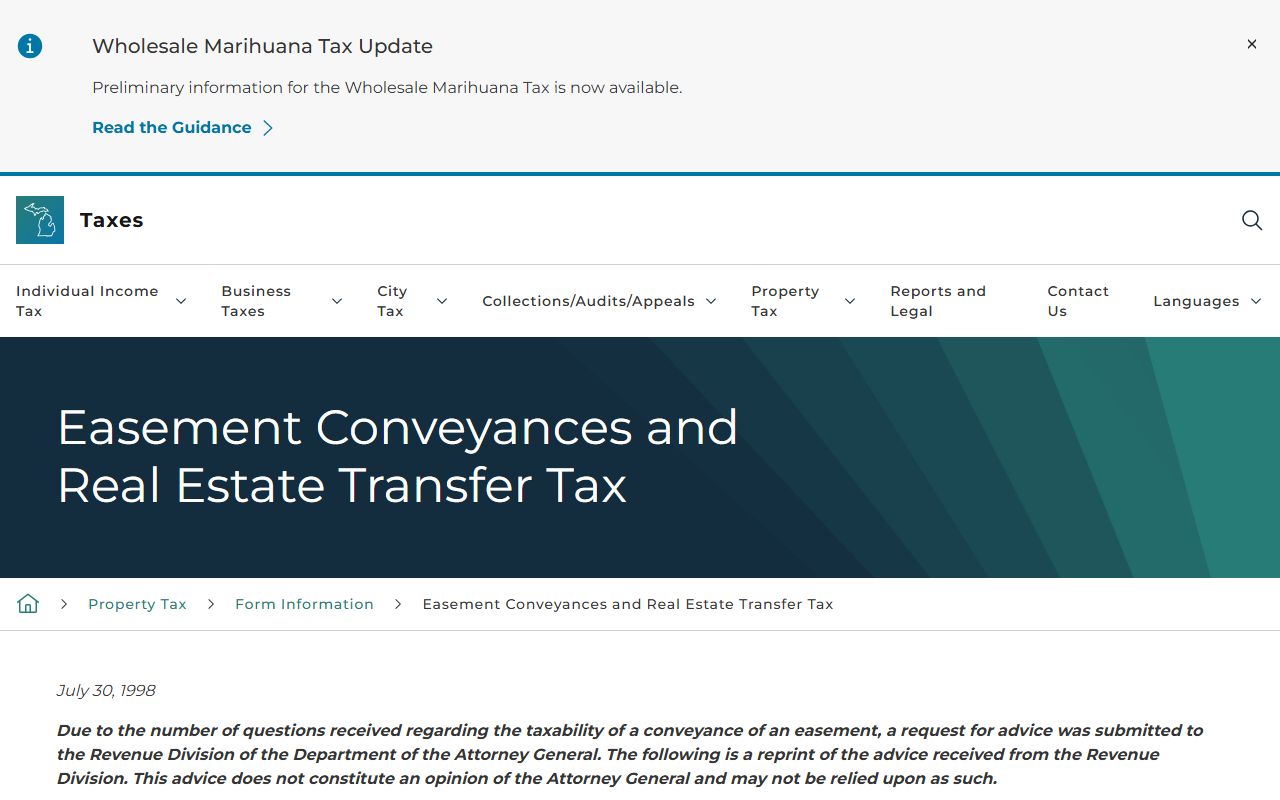
For more detail on how transfer tax applies to easements and conveyances, visit the Michigan Treasury easement conveyances page.
Additional Huron County Property Resources
The Michigan Department of Treasury maintains a statewide Register of Deeds resource page with information on recording rules, fees, and transfer tax across all counties. The transfer tax page lists current rates and describes available exemptions in detail.
For questions about property tax assessments in Huron County, contact the county equalization department. Assessment appeals go through the March Board of Review at the township level. The Register of Deeds office handles recording only and cannot advise on tax disputes. For legal questions about deed form or title issues, contact a Michigan real estate attorney or a title company licensed to operate in Huron County.
Nearby Counties
Huron County shares borders with several Thumb Region and mid-Michigan counties, each maintaining separate deed records.