
Luce County Deed Records Search
Deed records in Luce County are maintained by the Register of Deeds office in Newberry, and all searches must be done in person or by mail since the county does not offer an online search portal. The office handles warranty deeds, quitclaim deeds, land contracts, mortgages, and other property documents for this Upper Peninsula county, and staff can assist researchers who visit the courthouse on West Harrie Street.
Luce County Deed Records
Luce County Register of Deeds Office
The Luce County Register of Deeds is located at 407 West Harrie Street, Newberry, MI 49868. The office is open Monday through Friday from 8:00 AM to 4:00 PM. If you need access to the records vault, you must schedule an appointment for vault access, which is available from 8:00 AM to 3:30 PM. Call ahead at 906-293-5521 to arrange your visit. The fax number is 906-293-5553.
Because Luce County does not have an online index or search portal, researchers have two options: visit in person or submit a written mail request. Mail requests should be sent to the address above and should include as much identifying information as possible, such as the grantor and grantee names, the legal description or parcel number, and the approximate recording date range. Staff will search the index and respond with copies or a no-record response.
The office maintains records for all recorded property transactions in Luce County. This includes warranty deeds, quitclaim deeds, land contracts, mortgage instruments, liens, easements, and plat documents. If you are buying or selling property in the Newberry area or anywhere else in the county, the Register of Deeds office is the official place to confirm recorded ownership and encumbrances.
The Luce County government website at lucecountymi.com provides basic department information for the Register of Deeds. The screenshot below shows the department page as it appears online.
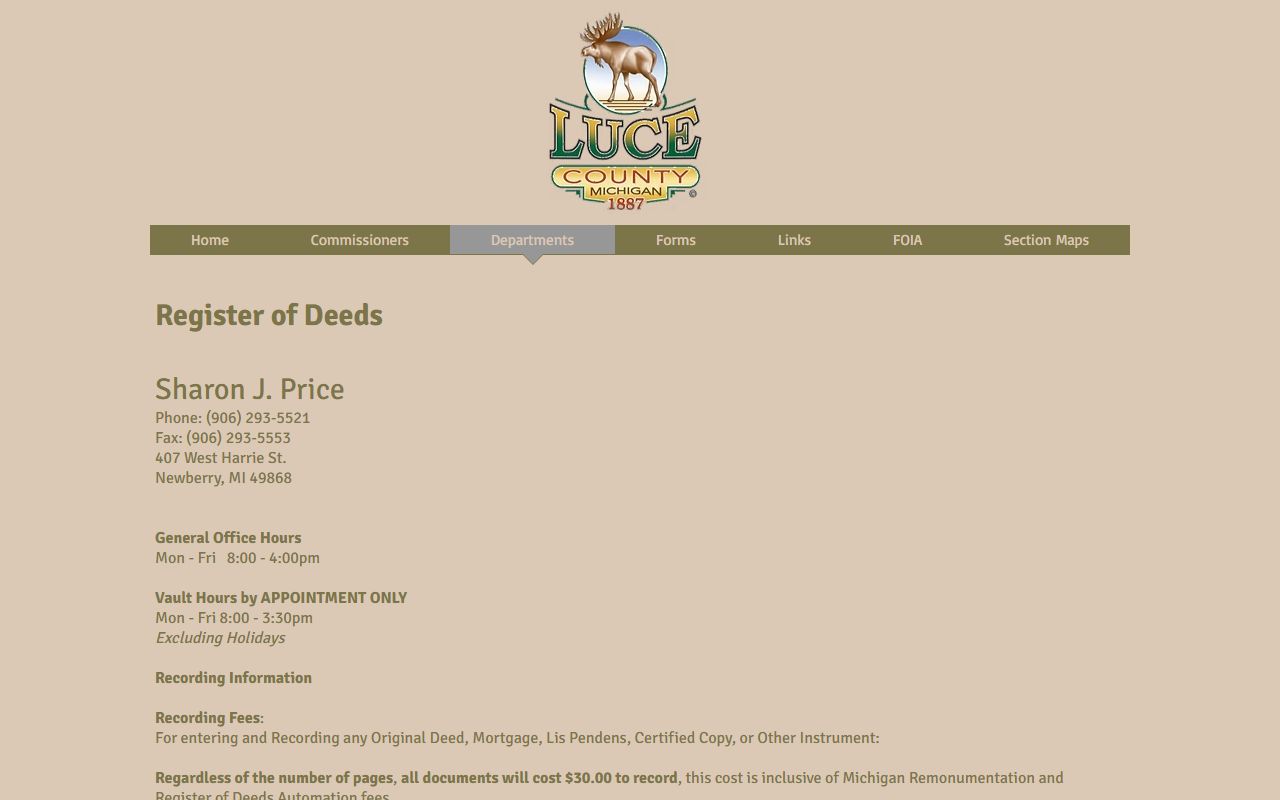
The department page lists contact details and general filing guidance, though it does not include an online search tool for deed records.
Tax Certificate Requirement
Luce County has a specific local requirement that buyers and sellers must know before recording certain documents. A tax certificate must be obtained from the County Treasurer before recording warranty deeds and land contracts. The certificate costs $5.00 and confirms that property taxes are paid and in good standing.
Skipping this step will cause your document to be rejected at the counter. The Treasurer's office is also in the courthouse, so you can typically get the certificate and then walk down to the Register of Deeds in the same visit. If you are mailing documents for recording, obtain the tax certificate first and include it with your submission. This requirement does not apply to all document types, but it does apply to the most common transfers, so confirm with the office if you are unsure whether your specific document type requires it.
Recording Fees and Transfer Tax
The flat recording fee in Luce County is $30 per document, set by state law under MCL 600.2657. This fee covers the recording of most standard deed instruments. If you need copies of recorded documents, the fee is $1.00 per page. Certified copies cost $5.00 plus the per-page copy fee.
Michigan's real estate transfer tax applies to most deed recordings. The combined rate works out to $8.60 per $1,000 of the property's sale price or value. This breaks down as $3.75 per $500 for the state transfer tax and $0.55 per $500 for the county transfer tax. The seller typically pays transfer tax, and a valuation affidavit is required at the time of recording to document the sale price. Certain transfers are exempt, including transfers between spouses, foreclosure deeds, and some family transfers. Ask the office if your situation may qualify for an exemption.
Document Formatting Requirements
Michigan law sets specific formatting standards for documents recorded with the Register of Deeds. Under MCL 565.201, documents must meet certain requirements to be accepted for recording. The paper must be white, at least 20-pound weight, and 8.5 by 11 inches or 8.5 by 14 inches. The print must be legible, in black ink, and no smaller than 10-point font.
The first page must include a top margin of at least 2.5 inches for the recording data block. All other margins must be at least 0.5 inches. The document must identify the drafter, include the name and address of the person to whom the document should be returned after recording, and contain the legal description of the property. If your document does not meet these formatting rules, the Register of Deeds office will reject it and return it unrecorded.
A completed Property Transfer Affidavit (form L-4260) is also required for most deed recordings. This form is submitted to the local assessor's office, not the Register of Deeds, but it is part of the full transfer process. Buyers typically complete this form within 45 days of the transfer date.
E-Recording in Luce County
Michigan's Uniform Real Property Electronic Recording Act, commonly called MURPERA and codified at MCL 565.841, permits counties to accept documents submitted electronically through approved vendors. E-recording eliminates the need to mail or deliver paper documents and can speed up recording turnaround time significantly.
Check with the Luce County Register of Deeds at 906-293-5521 to confirm whether the office accepts e-recording submissions and which vendors are approved. Common statewide vendors include Simplifile (reachable at 1-800-460-5657), ePN, CSC, and Indecomm. Title companies, lenders, and attorneys who record documents frequently often prefer e-recording for its speed and the ability to get confirmed recording data without waiting for mail return.
Michigan Race-Notice Recording Law
Michigan operates under a race-notice recording system. This means the first buyer to record their deed, provided they had no prior notice of a competing claim, wins the legal priority dispute. Recording promptly after closing is not just a formality. It is the act that protects your ownership rights against later claims or liens that might otherwise take priority.
If you close on a property in Luce County and delay recording your deed, a subsequent lien or another deed that gets recorded before yours could take priority over your ownership claim. This is why title insurance and prompt recording are standard parts of every real estate closing. The Register of Deeds office date-stamps and assigns a liber and page number (or document number) to each recorded instrument, creating the public record of when each document was received.
The following screenshot from the Michigan Treasury illustrates the state's approach to deed recording and ownership conveyances.

These guidelines apply statewide and are relevant to all property transfers recorded in Luce County and throughout Michigan.
Searching Luce County Property Records
Since Luce County does not have an online search tool, the main options for researching deed history are visiting the courthouse vault or hiring a title company or abstract firm to conduct the search on your behalf. When visiting the vault, note that access is by appointment only and closes at 3:30 PM even though the main office stays open until 4:00 PM. Plan accordingly and call ahead.
When requesting a search by mail, be specific about the time period you need. A chain-of-title search going back many decades may require additional time and could involve multiple volumes of the index. The office can advise on expected turnaround time when you call. Copy fees are $1.00 per page, so a complex title search with many documents can add up in copy costs. Abstract companies often have existing familiarity with the county's index system and can do searches efficiently.
Property tax records, which are separate from deed records, are maintained by the County Treasurer and the township or city assessors. If you need to look up parcel information, tax payment status, or assessed values alongside deed history, you will need to contact those offices in addition to the Register of Deeds.
Nearby Counties
Luce County borders several other Upper Peninsula counties, each with its own Register of Deeds office for property records in those jurisdictions.