
Oceana County Deed Records
Deed records in Oceana County are filed with the Register of Deeds office in Hart, which serves as the official repository for all recorded property instruments in the county, including warranty deeds, quitclaim deeds, land contracts, mortgages, easements, and liens. This office keeps the chain of title for every parcel in the county, and those records are open to the public. Anyone can search the index and request copies of recorded documents, whether for a real estate transaction, a title search, an estate matter, or general research into property ownership history.
Oceana County Deed Records
Oceana County Register of Deeds Office
The Register of Deeds for Oceana County is located at 100 S. State St., P.O. Box 487, Hart, MI 49420. You can reach the office by phone at 231-873-3645. The county website at co.oceana.mi.us has current information about the office, including contact details and any changes to office hours or services. For document submissions by mail, use the P.O. Box. For in-person visits, use the street address.
The office records and indexes all real property instruments for Oceana County. Staff will confirm that a document meets the basic requirements before recording it. Documents that are missing required information or that don't meet formatting standards will be returned. It is worth reviewing the requirements before you submit, especially if you prepared the document yourself without the help of an attorney or title company.
The office is the starting point for any title search in Oceana County. All recorded instruments are indexed by grantor and grantee name, and a parcel-based index allows searches by legal description.
The image below, from the Michigan Treasury, shows state-level guidance on deed recording and change-of-ownership requirements that apply to all Michigan counties including Oceana.
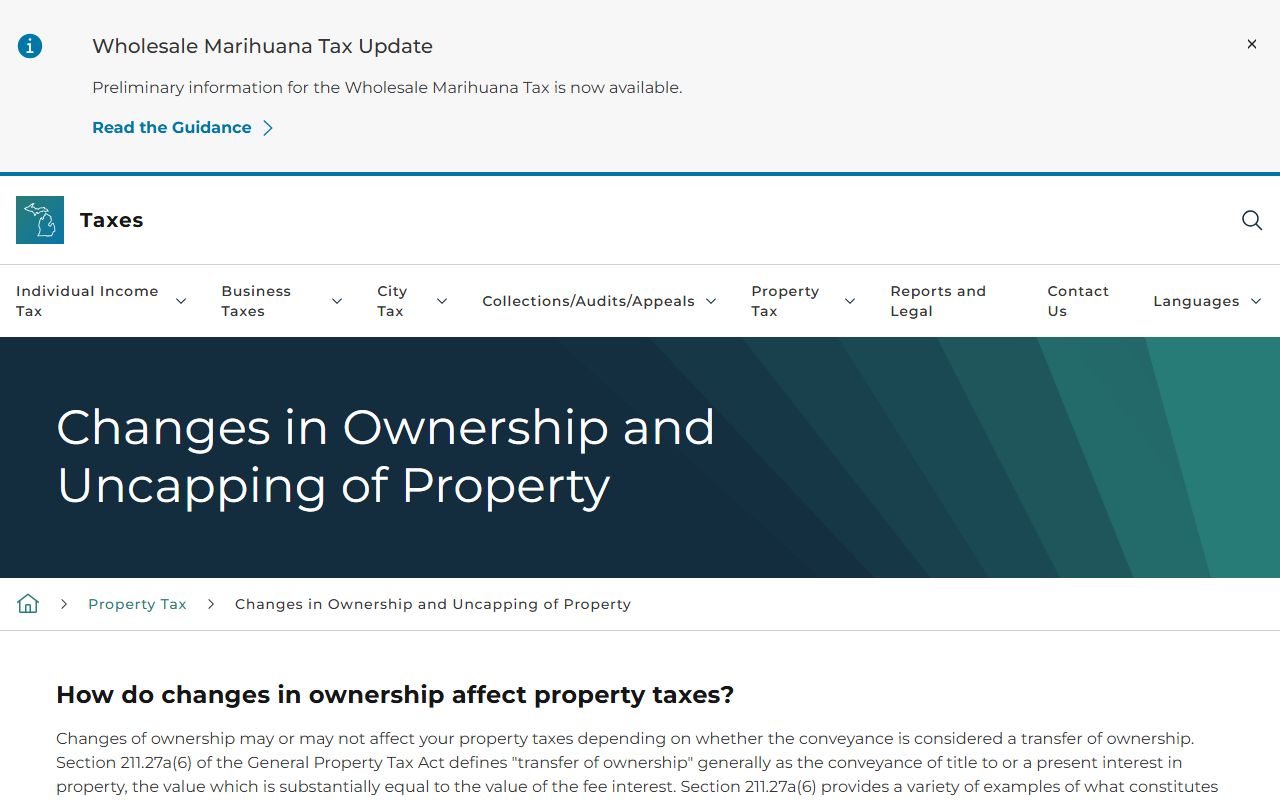
The state guidelines shown here govern how property transfers must be reported to assessing units, which is a step that happens alongside but separately from recording the deed with the county.
Recording Fees and Document Requirements
Michigan law sets the recording fee at $30 for most documents under MCL 600.2657. This flat rate applies to deeds, mortgages, discharges, assignments, and most other instruments filed with the Register of Deeds. Copies of recorded documents cost $1 per page. Certified copies require a $5 certification fee in addition to the per-page copy cost.
Formatting requirements for recorded documents are set by MCL 565.201. The first page must have a top margin of at least 2.5 inches so there is room for the recording stamp. All other margins must be at least 0.5 inches. The document must be printed in a legible font of at least 10 points. The preparer's name and address must appear on the first page, along with the address for tax bill delivery after recording and a full legal description of the property.
A street address is not a legal description. You need the full metes-and-bounds description or the lot and plat reference from the county's records.
Transfer Tax and the Valuation Affidavit
Real estate transfer tax applies to most property sales in Michigan. The combined state and county tax rate totals $8.60 per $1,000 of the sale price. The state charges $3.75 per $500, and the county adds $0.55 per $500. The seller pays this tax at closing. Tax is calculated on the actual amount paid for the property, not the assessed value or any other estimate.
Along with the transfer tax, a property transfer affidavit must be filed with the local assessor within 45 days of the transfer. This document tells the assessor who now owns the property so they can update the tax rolls. The affidavit is not recorded with the Register of Deeds. It goes to the township or city assessor where the property is located. Missing the 45-day deadline results in a penalty assessed against the new owner.
Some transfers are exempt from the transfer tax. Transfers between spouses, transfers that correct a prior deed error, and certain transfers to or from government entities may qualify for exemption. The basis for any claimed exemption should be stated on the deed itself.
The image below from the Michigan Treasury shows easement and conveyance tax information that provides additional context for how transfer taxes are applied to different types of property instruments in Michigan.
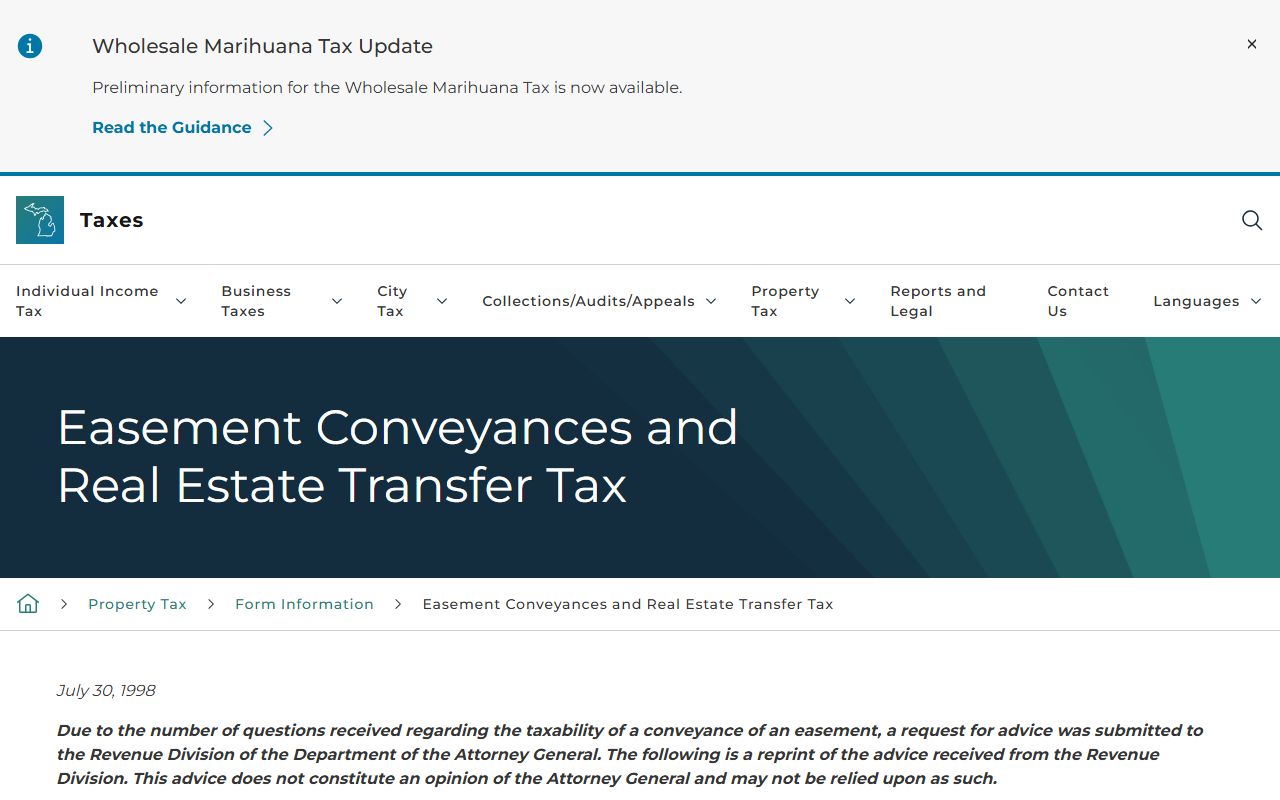
This resource is helpful for understanding which conveyances are subject to the transfer tax and which may qualify for an exemption under Michigan law.
Types of Property Records Filed in Oceana County
The Register of Deeds office handles a wide range of instruments beyond basic deeds. Warranty deeds are the most common type filed in arm's-length property sales. A warranty deed includes covenants from the seller guaranteeing that the title is clear. Quitclaim deeds convey only the grantor's interest, with no guarantees, and are used frequently in family transfers, gift transactions, and trust transfers.
Land contracts are common in rural areas like Oceana County, especially for transactions involving seasonal properties, vacant land, or buyers who can't qualify for conventional financing. Under a land contract, the seller keeps legal title until the buyer pays the full price. The contract is recorded to put future parties on notice of the buyer's equitable interest in the property.
Mortgages are recorded to establish the lender's security interest. When the loan is paid off, a discharge or release must be recorded to clear the lien. Easements, right-of-way agreements, and deed restrictions are also part of the public record. These documents can significantly affect how a property can be used, so it's important to search for them when reviewing title.
E-Recording Under MURPERA
Michigan adopted the Uniform Real Property Electronic Recording Act, known as MURPERA, at MCL 565.841. This law allows counties to accept documents submitted electronically through approved providers. E-recording is faster and more reliable than mailing documents. It also provides immediate confirmation of the recording date and time, which is critical in Michigan's race-notice recording system.
Approved providers for e-recording in Michigan include Simplifile (reachable at 1-800-460-5657), ePN, CSC, and Indecomm. These providers connect title companies, lenders, and closing agents directly to the county's recording system. Contact the Oceana County Register of Deeds at 231-873-3645 to confirm which providers are accepted and to get any submission requirements specific to this county.
For those who don't use e-recording, documents can be submitted in person during office hours or mailed to the P.O. Box. Mail-in submissions should include the recording fee and a return envelope for the recorded document.
Searching Deed Records in Oceana County
Deed records are public. Anyone can search the index and get copies of recorded documents. In-person searches can be done at the Hart courthouse during office hours. Staff can help you find documents in the index. If you know the name of a prior owner or the legal description of the parcel, you can usually locate the relevant instruments quickly.
For a complete title search, you need to trace the chain of title back far enough to establish a clear record of ownership. This typically means searching back at least 40 years, though some lenders and title insurers require a longer search period. You also need to check for any liens, encumbrances, or restrictions that may affect the property. A professional title searcher or title company can do this work for you if needed.
The deed index at the Register of Deeds is organized by grantor and grantee name. If you are looking for all instruments affecting a specific parcel over time, the parcel-based index organized by legal description is more efficient. Both are available at the office.
Nearby Counties
Oceana County is bordered by four other Michigan counties, each with its own Register of Deeds office for property records.