
Ogemaw County Deed Records Search
Deed records in Ogemaw County are maintained by the Register of Deeds office in West Branch, where all property transfers, mortgages, land contracts, easements, and related instruments are filed and kept as part of the permanent public record. The office serves as the official source for ownership history and title information on all parcels within the county, and its records are open to anyone who needs to look up a property, verify a lien release, research a chain of title, or confirm the current owner of a specific parcel. Both in-person and electronic access options are available for most searches.
Ogemaw County Deed Records
Register of Deeds Office in West Branch
The Ogemaw County Register of Deeds is located at 806 W. Main St., West Branch, MI 48661. Call the office at 989-345-0728 with questions about recording requirements, fee amounts, or to check whether a document has been recorded. The county website at ogemawcountymi.gov has current information about the office and available services.
The Register of Deeds records and indexes all instruments affecting real property in Ogemaw County. This includes deeds of every type, mortgages and mortgage assignments, mortgage discharges, land contracts, easements, right-of-way agreements, liens, plats, and various other recorded instruments. Once recorded, each document becomes part of the permanent public record and can be viewed or copied by anyone.
Staff at the office will review documents before recording to check that they meet state formatting requirements. Documents that are incomplete or improperly formatted will be returned without recording. If you have questions about how to prepare a document correctly, it's better to call ahead and ask than to submit something that gets rejected.
The image below from the Michigan Treasury shows the state's change-of-ownership guidelines, which affect all property transfers in Michigan including those in Ogemaw County.
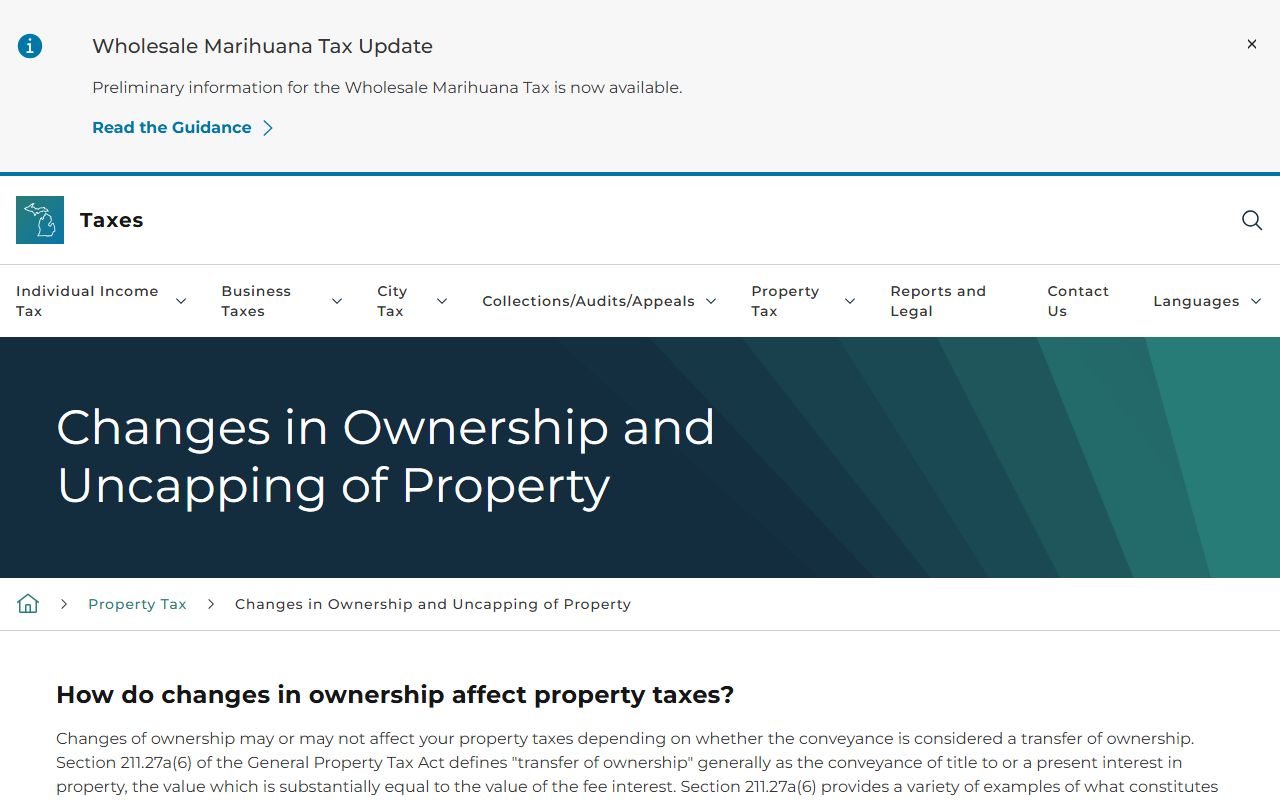
These guidelines explain the state-level requirements that accompany the recording of a deed, including the property transfer affidavit that must be filed with the local assessor after a sale.
Fees for Recording and Copies
The recording fee in Michigan is $30 for most instruments, as set by MCL 600.2657. This covers deeds, mortgages, and most other property-related documents. The fee does not vary based on the number of pages or the value of the property being conveyed. Copies of recorded documents cost $1 per page. Certified copies, which carry the official county seal and are required for certain legal and court uses, cost $5 for the certification plus $1 per page.
When submitting documents in person or by mail, include a check or money order for the correct recording fee made payable to the Ogemaw County Register of Deeds. If you are mailing a document and want the original returned after recording, include a self-addressed stamped envelope large enough for the document.
If you send the wrong fee amount, the document will be returned without recording. Double-check the fee before you send anything.
Formatting Requirements for Recorded Documents
Michigan law at MCL 565.201 sets the formatting requirements that all recorded documents must meet. The first page must have a top margin of at least 2.5 inches. This space is reserved for the recording stamp and information entered by the Register of Deeds. All other margins on all pages must be at least 0.5 inches. The text must be printed in a clear, legible font of at least 10 points.
The first page must identify the person who prepared the document (their name and address), the address where the property tax bill should be sent after recording, and a complete legal description of the property. A street address alone is not a legal description. You need the metes-and-bounds description, the lot and subdivision reference, or the quarter-section description depending on how the parcel is described in the county's records.
If the document references an existing recorded instrument (like a prior mortgage being discharged), include the liber and page number of the prior instrument so it can be cross-referenced in the index.
Real Estate Transfer Tax
Michigan imposes both a state and a county real estate transfer tax when property is sold. The state tax is $3.75 per $500 of value, and the county adds $0.55 per $500. The total comes to $8.60 per $1,000 of the sale price. The seller pays this tax at closing. Tax stamps or receipts showing payment are typically included with the deed when it is submitted for recording.
A property transfer affidavit must also be filed with the local assessor within 45 days of the transfer. This affidavit is separate from the deed recording process. It goes to the township or city assessor responsible for the parcel, not to the Register of Deeds. The affidavit tells the assessor who owns the property so they can update the tax rolls and determine whether the transfer triggers a reassessment of the property's taxable value.
Transfers exempt from the transfer tax include transfers between spouses, transfers to correct deed errors, and certain government transfers. If a transfer qualifies for an exemption, the deed should state the basis for the exemption on its face.
The image below from the Michigan Treasury shows information about delinquent taxes and how they can affect property records and transfers in Michigan.
Before completing a purchase, it's worth checking whether there are any delinquent taxes on the property, since unpaid taxes can become a lien that transfers with the deed.
Common Deed Types in Ogemaw County
Warranty deeds are the most common instrument recorded in arm's-length property sales. They include covenants from the seller guaranteeing clear title and the right to convey. Quitclaim deeds, which transfer only the grantor's interest without any title guarantees, are used often in family transfers, estate distributions, and situations where the parties already know the state of the title and don't need the warranty.
Land contracts are common in Ogemaw County, particularly for vacation properties, rural parcels, and transactions where the buyer is not using a bank. Under a land contract, the seller holds legal title and the buyer makes payments over time. When the balance is paid in full, the seller transfers the deed. The land contract itself should be recorded so that the buyer's interest is protected against third parties.
Mortgages, easements, deed restrictions, and plats round out the most frequently recorded instruments. The office also handles affidavits of survivorship, personal representative deeds filed in probate proceedings, and trustee deeds for property held in trust.
E-Recording and Michigan's Electronic Recording Law
Michigan's Uniform Real Property Electronic Recording Act at MCL 565.841 permits counties to accept electronic submissions from approved providers. E-recording is used primarily by title companies, lenders, and attorneys who record documents frequently. It is faster than mail and avoids the uncertainty of in-person submission timing.
Approved e-recording providers include Simplifile (1-800-460-5657), ePN, CSC, and Indecomm. These providers charge their own submission fees on top of the $30 county recording fee. Call the Ogemaw County Register of Deeds at 989-345-0728 to confirm which providers are currently accepted and whether there are any specific requirements for electronic submissions in this county.
Individuals and one-time filers who don't have accounts with e-recording providers can still submit documents in person or by mail. In-person submissions during office hours typically result in same-day recording if all requirements are met.
Nearby Counties
Ogemaw County is located in northeast-central Michigan and borders several other counties, each with its own Register of Deeds office.