
Find Deed Records in Kalamazoo, Michigan
Deed records for Kalamazoo, Michigan are filed and maintained by the Kalamazoo County Register of Deeds, which has preserved property transfer documents going back to 1831. If you need to look up ownership history, check a legal description, or confirm whether a lien has been released on a Kalamazoo property, the county office is your primary source. The city itself does not record deeds, but the Kalamazoo City Assessor maintains valuation data that works alongside recorded instruments to give a full picture of any parcel.
Kalamazoo Deed Records
Kalamazoo County Register of Deeds
The Kalamazoo County Register of Deeds operates out of 201 W. Kalamazoo Avenue, Kalamazoo, MI 49007. In Kalamazoo County, the Register of Deeds and the County Clerk share a combined office, which means some administrative functions are handled together. The main phone line is 269-383-8970, and an alternate line, 269-383-8771, may also reach staff depending on the department. This is the office that accepts, indexes, and returns all recorded real property documents for the county, including every parcel within city limits.
The office has kept deed records since 1831. That depth of history matters for title researchers working on older Kalamazoo properties, since chain-of-title searches sometimes go back decades or longer. Grantor and grantee indexes allow you to trace ownership forward and backward by name. The office also maintains plat maps for subdivisions throughout the county.
Certified copies cost $15 for the first page and $5 for each additional page. Plain copies run $1 per page. If you just need to verify basic information and don't need a certified copy, the $1 rate keeps costs low.
What Gets Recorded at the County Level
When real estate changes hands in Kalamazoo, the deed must be recorded with the county, not the city. Warranty deeds, quitclaim deeds, land contracts, and deeds in lieu of foreclosure all go to the same office at 201 W. Kalamazoo Avenue. Mortgages, releases of mortgage, and liens also get recorded there. The county register keeps all of these in one indexed system.
Michigan is a race-notice state. That means the first party to record a deed in good faith wins priority over earlier unrecorded transfers. For anyone buying property in Kalamazoo, prompt recording is important. A deed that sits unrecorded gives a later buyer or lender no notice of that prior transfer, which can create serious legal problems.
The formatting rules that apply to every deed filed in Michigan come from MCL 565.201. That statute sets out margin requirements, font size minimums, and the return address block that must appear on every instrument. Documents that don't meet these standards get returned for correction before recording.
Recording Fees and Transfer Tax
Michigan law sets a flat $30 recording fee for most deeds and mortgages. That rate comes from MCL 600.2657. It covers documents up to the standard page limit; longer documents may cost more. Copies of recorded documents run $1 per page. If you need an official certified copy, add $5 for the certification stamp on top of the per-page copy fee.
Beyond the recording fee, most deed transfers in Michigan also carry a state and county transfer tax. The combined rate works out to $8.60 per $1,000 of the sale price. So on a $200,000 home, the total transfer tax would be $1,720. Some transfers are exempt, including those between family members, transfers resulting from divorce judgments, and certain foreclosure-related conveyances. It's worth checking whether your transaction qualifies for an exemption before paying.
The Kalamazoo City Website and Assessor
The city of Kalamazoo maintains its official site at kalamazoocity.org. While the city does not record deeds, the city assessor plays a key role in property research because Michigan requires that all real property be assessed at 50% of true cash value. That assessed value, sometimes called state equalized value or SEV, shows up on property tax bills and in many online search results.
The screenshot below shows the Kalamazoo city website, which is a useful starting point when you need contact information for city departments, property tax payment portals, or links to parcel data tools.

From the city site, you can navigate to assessor resources and find parcel-level data that complements what's in the Register of Deeds. The assessor's office is accessible through Kalamazoo City Hall. While the city assessor can tell you the current assessed value and ownership as of the last assessment, the Register of Deeds holds the actual recorded instruments that legally transfer title.
How to Search Kalamazoo Deed Records
You can search Kalamazoo County deed records in person at the Register of Deeds office on W. Kalamazoo Avenue. Staff can assist with name searches and parcel lookups. Bring as much information as you can, such as the grantor or grantee name, approximate recording date, or parcel identification number.
Online access is also available through the county's web portal. Kalamazoo County has moved toward digitized records access, and many instruments recorded in recent decades can be found through the county website. Older records may require an in-person visit or a written request.
The screenshot below is from the Michigan Treasury, showing state-level guidance on change-of-ownership reporting. This is relevant when a Kalamazoo deed is recorded, because the new owner must file a Property Transfer Affidavit within 45 days. Failure to file can affect how the property's taxable value is calculated going forward.
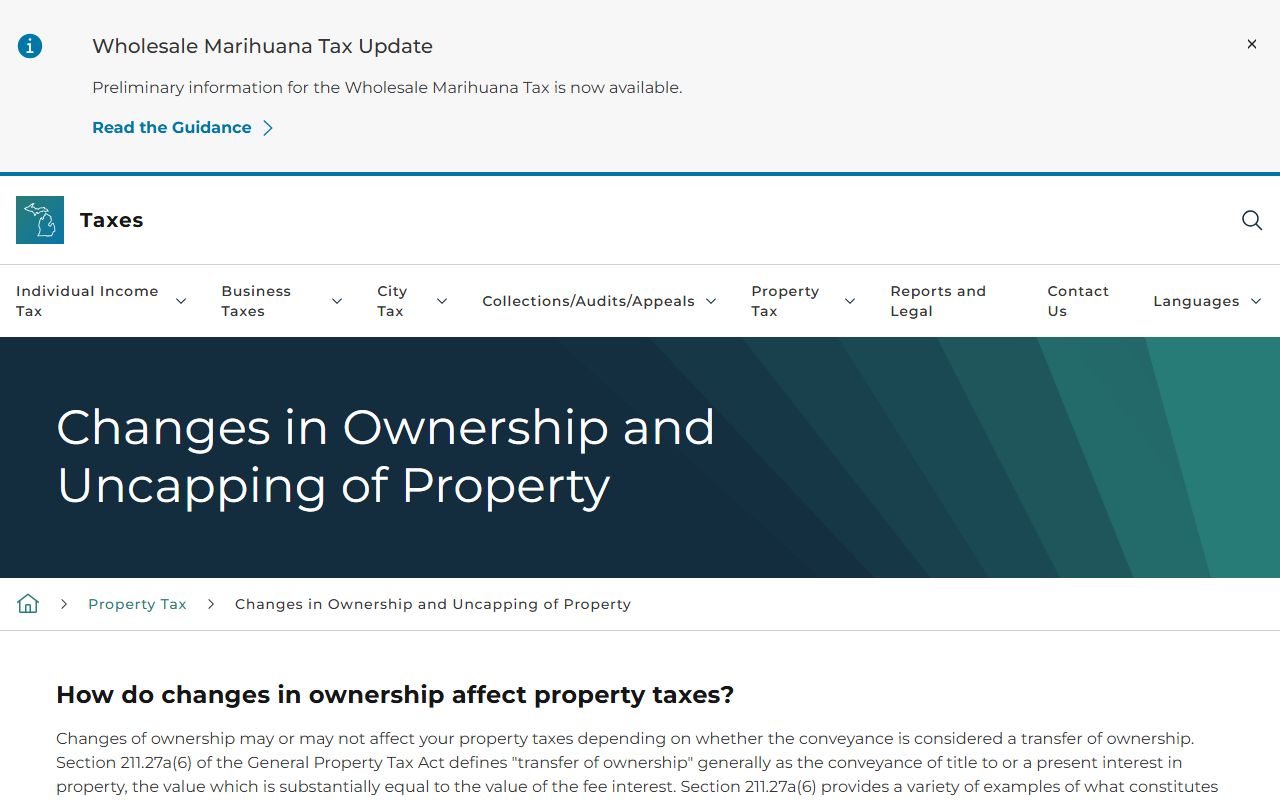
The Property Transfer Affidavit (Form 2766) goes to the city or township assessor, not the county register. So after a deed is recorded at the county level, the next step is submitting that form to the Kalamazoo City Assessor's office. Both steps are needed to fully complete a property transfer.
MURPERA and Electronic Recording
Michigan's Uniform Real Property Electronic Recording Act, known as MURPERA and codified at MCL 565.841, gives counties the authority to accept electronically submitted documents. Kalamazoo County participates in e-recording through platforms such as Simplifile, ePN, CSC, and Indecomm. Title companies and lenders frequently use these services to record documents the same day as closing, which cuts down on turnaround time compared to mailing paper originals.
E-recording does not change the legal effect of the document. A deed submitted electronically and accepted by the Register of Deeds has the same force as one handed over the counter. The indexing and return process is the same; only the delivery method differs.
The screenshot below shows Michigan Treasury guidance on easement conveyances and related tax information, which is relevant for Kalamazoo properties that include utility or access easements in their deed descriptions.
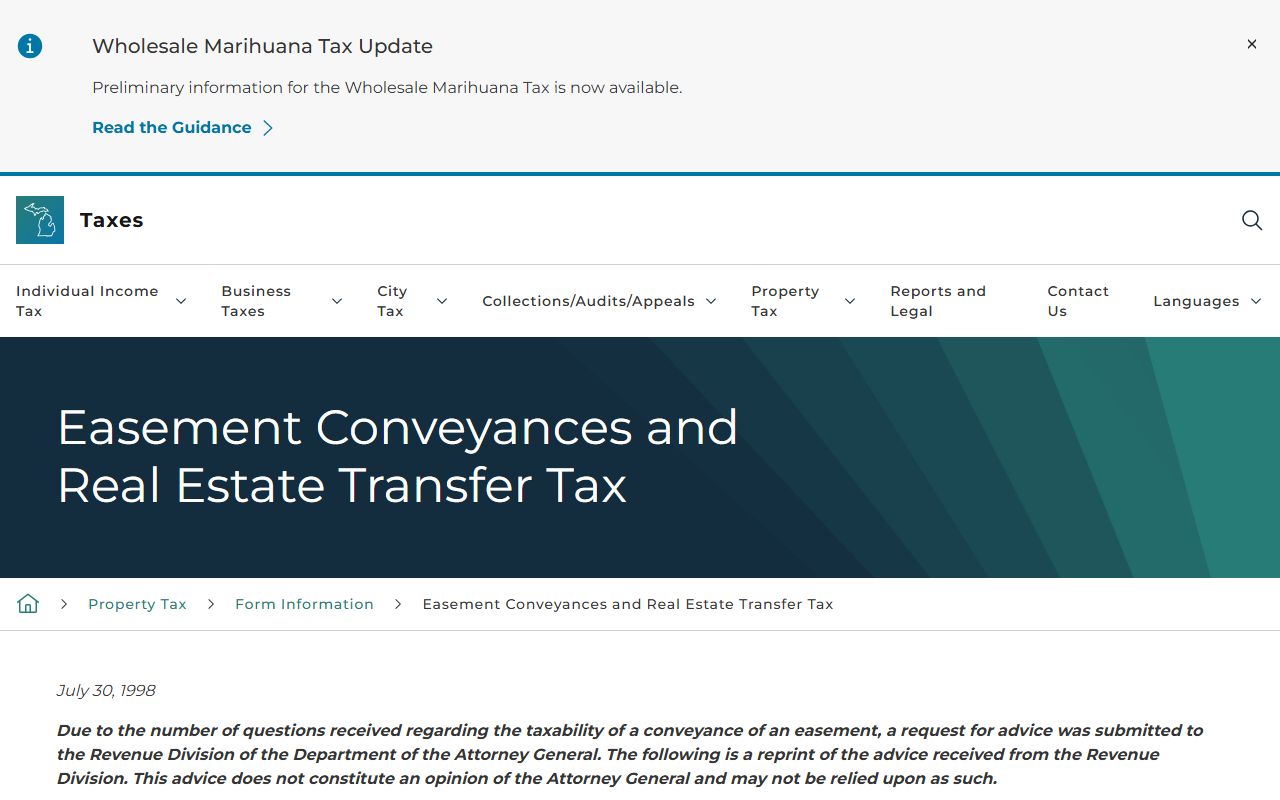
Easements recorded in Kalamazoo County show up in the same index as standard deeds. If you're researching a property and see references to utility easements or right-of-way grants, those documents are accessible through the same register office and search process.
Delinquent Taxes and Title Research
Before completing any property purchase in Kalamazoo, it's wise to check for delinquent taxes. Michigan has a tax foreclosure process, and properties with unpaid taxes can be subject to forfeiture and eventual foreclosure by the county treasurer. Delinquent tax information is separate from deed records but is equally important for a clean title.
The screenshot below shows Michigan Treasury information about delinquent tax procedures, which applies to all Michigan counties including Kalamazoo.
If a property in Kalamazoo has gone through tax forfeiture or foreclosure, that history will often show up in the deed record as a treasurer's deed or a related conveyance. Checking both deed records and the county treasurer's delinquent tax rolls gives you a more complete picture of any title issues before you buy.
You can contact the Kalamazoo County Treasurer's office separately from the Register of Deeds to get current tax status on any parcel. The county website at kalcounty.com links to both offices. The Register of Deeds site is at kalcounty.com/rod/.
Nearby Cities
Other Michigan cities with deed records information available through this site are listed below.