
Lansing Deed Records
Deed records for Lansing, Michigan are filed and maintained at the Ingham County Register of Deeds, which holds ownership transfers, warranty deeds, quitclaim deeds, and other recorded property instruments going back well over a century. Most of the city falls within Ingham County, though a small western portion of Lansing extends into Eaton County, so checking the right county office matters when you research a specific parcel. This guide covers where to search, what fees apply, how to order copies, and which city offices can round out your property research.
Lansing Deed Records
Ingham County Register of Deeds
The office that holds Lansing deed records is the Ingham County Register of Deeds, located at the Ingham County Courthouse, 341 S. Jefferson, Room 201, Mason, MI 48854. The phone number is 517-676-7216. You can also visit the office's website at ingham.org/registerofdeeds for online search tools and filing information.
The office records all real property instruments for Ingham County, including warranty deeds, quitclaim deeds, land contracts, mortgages, and lien releases. Each document is indexed by grantor and grantee name and by parcel number, making searches straightforward once you have a party name or address.
One thing to know before you visit: records prior to 1960 are kept in a vault that requires an appointment. Vault hours run Monday through Friday, 8:30 a.m. to 4:00 p.m. If your research involves older transfers, call the office first so staff can pull the books you need. Newer records are available at the public terminals in the office itself.
The Small Eaton County Portion
A slice of Lansing's western side falls inside Eaton County rather than Ingham. If a parcel you are researching sits near the county line, it may be recorded at the Eaton County Register of Deeds instead. That office is located at 1045 Independence Blvd., Charlotte, MI, and can be reached at 517-543-4203. Always confirm which county your parcel belongs to before ordering copies. The fastest way is to look up the property in the city assessor's system, which will show the county designation for each parcel.
Recording Fees and Transfer Tax
Michigan law sets a flat $30 recording fee for most real property documents under MCL 600.2657. That covers the first page and any additional pages of a standard deed. Certified copies run $5 per document, and plain copies are $1 per page. These amounts apply whether you record in person, by mail, or through an e-recording platform.
Transfer tax is separate from the recording fee. Michigan charges $8.60 per $1,000 of the sale price, which combines the state real estate transfer tax and the county transfer tax. The seller typically pays this at closing. Documents that qualify for an exemption, such as transfers between spouses or to a trust, must include a written statement explaining the exemption basis. Without that statement, the register of deeds will collect the full tax.
E-recording is available through platforms like Simplifile, ePN, CSC, and Indecomm. Title companies and law firms use these services regularly because they cut turnaround from days to hours. Individual homeowners can also use e-recording, though most choose to submit by mail or in person.
How Lansing Deed Records Are Organized
Michigan follows a race-notice recording system. That means the first party to record a deed in good faith and without prior knowledge of a competing claim wins priority. Recording promptly after closing protects a buyer's ownership against later claims. This principle underpins why lenders require deeds and mortgages to be recorded before a loan funds.
Deed formatting in Michigan is governed by MCL 565.201, which sets out minimum requirements for margins, font size, and legibility. A deed that does not meet these standards may be rejected at the counter or charged a non-conforming document fee. The grantor's signature must be notarized, and the grantee's name and mailing address must appear on the face of the document.
The Michigan Uniform Real Property Electronic Recording Act, known as MURPERA under MCL 565.841, governs electronically recorded documents and confirms that an electronic record has the same legal effect as a paper original once it is accepted by the register of deeds.
Here is a look at the Lansing city website, which points residents toward property resources including assessor data and permit information.
The city's main portal links to several departments that support deed and property research beyond what the county register holds.
City of Lansing Assessor and Property Data
The City of Lansing Assessor maintains property records that run parallel to deed records. Assessor data includes current ownership, taxable value, assessed value, parcel dimensions, and property class. You can search this data online through BS&A Online at bsaonline.com, which covers property records, tax search history, and building records for Lansing parcels.
Below is the BS&A Online search portal used for Lansing property and assessment lookups.
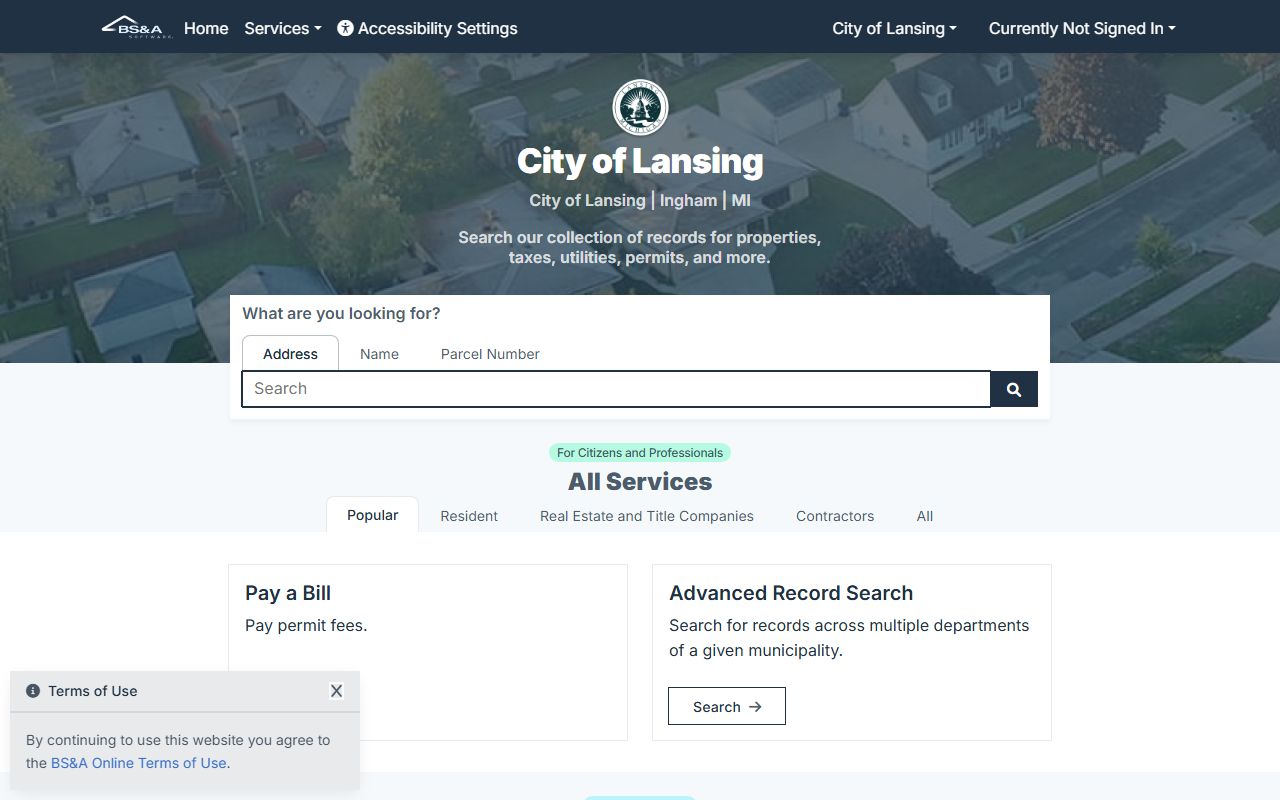
The assessor database is particularly useful when you know an address but not the owner's name, because you can search by address to find the current owner and then cross-reference that name in the Register of Deeds index to pull the recorded deed.
When a property is sold, the buyer must file a Property Transfer Affidavit with the local assessor within 45 days of the transfer. This form tells the assessor to update the ownership record and triggers an uncapping of the taxable value to the state equalized value. Missing this deadline can result in penalties. The affidavit form is available through the city assessor's office.
Building Permits and Historical Records
The City of Lansing Building Safety Office sits at 316 N Capitol Ave, Lansing, MI 48933, phone (517) 483-4355. Permit records show construction, renovation, and demolition activity on a parcel. If you are buying property and want to know whether any work was done without a permit, the building department can pull the permit history by address. The online permits portal is at lansingmi.gov/252/Permits.
The Lansing permits portal makes it easy to search current and recent permit activity on any parcel within city limits.
For historical research, the Capital Area District Library holds City of Lansing building permits from 1930 through 1968. These older records are not online and must be reviewed in person at the library. They can help trace the development history of a property when combined with deed records from the same period.
How to Search and Order Copies
The Ingham County Register of Deeds offers online access through its website at ingham.org/registerofdeeds. The online index covers a significant portion of recorded documents and lets you search by name or parcel number. Some older records may only be available by visiting the office in person.
To order certified copies by mail, send a written request with the document number or book and page reference, along with a check for $5 per document. Plain copies are $1 per page. Include a self-addressed stamped envelope if you want the copies mailed back. Call 517-676-7216 to confirm the current process before mailing.
In-person searches are free at the public terminals. Staff can assist if you are unsure how to navigate the index. If you need vault records from before 1960, call ahead to schedule access during vault hours, Monday through Friday 8:30 a.m. to 4:00 p.m.
Title companies, attorneys, and abstractors who work in Lansing regularly can also order through e-recording platforms, which provide direct access to the indexing system and faster copy delivery.
Secondary Sources for Lansing Property Research
Beyond deed records, several other sources help build a full picture of a Lansing property. The Ingham County Equalization Department maintains property maps and parcel data. The Michigan Department of Treasury publishes guidelines on property transfer tax exemptions and change-of-ownership rules. The State Tax Commission oversees assessment standards statewide.
For properties with tax liens, the Ingham County Treasurer maintains delinquent tax records. A title search should always include a tax lien check because unpaid taxes can survive a property sale and become the buyer's liability if not cleared before closing.
Federal tax liens and judgments are recorded at the Register of Deeds as well, so they appear in the same index. A thorough search covers not just deed transfers but all recorded instruments against the grantor's name to catch liens, easements, and restrictions that run with the land.
Nearby Cities
These nearby Michigan cities also have deed records pages with county office details and local resources.