
Hillsdale County Deed Records Search
Hillsdale County deed records date back to 1835 and are maintained by the Register of Deeds in Hillsdale, with a full-text searchable online system that covers all recorded property documents for the county. The office records deeds, mortgages, liens, easements, and over a hundred other document types. Two online search options are available: a modern cloud version with full-text OCR search and an older version for searching by name, date, or liber. Property Fraud Alert, e-recording, and a transfer tax calculator are also available through the county website.
Hillsdale County Deed Records
Hillsdale County Register of Deeds Office
The Register of Deeds is at 33 McCollum St., Room 212, Hillsdale, MI 49242. Hours are Monday through Friday, 8:30 AM to 5:00 PM. Phone: 517-437-2231. Email: deeds@hillsdalecounty.gov. The county website at co.hillsdale.mi.us has full details on services and online search options.
The office records all instruments affecting real property in Hillsdale County. That includes warranty deeds, quitclaim deeds, mortgages, land contracts, easements, liens, and releases. Once filed, each document becomes part of the permanent public record and is searchable by anyone. Records in this county go all the way back to 1835, one of the longer historical records among Michigan's lower peninsula counties.
An important note: Hillsdale County does not accept personal checks. Payment must be in certified funds. This means a cashier's check, money order, or other certified payment. Call ahead to confirm accepted payment methods before visiting or mailing a request. Arriving with a personal check will require a second trip.
The Hillsdale County Register of Deeds page shows the two online search options, current fee schedule, and access to the Property Fraud Alert registration system.
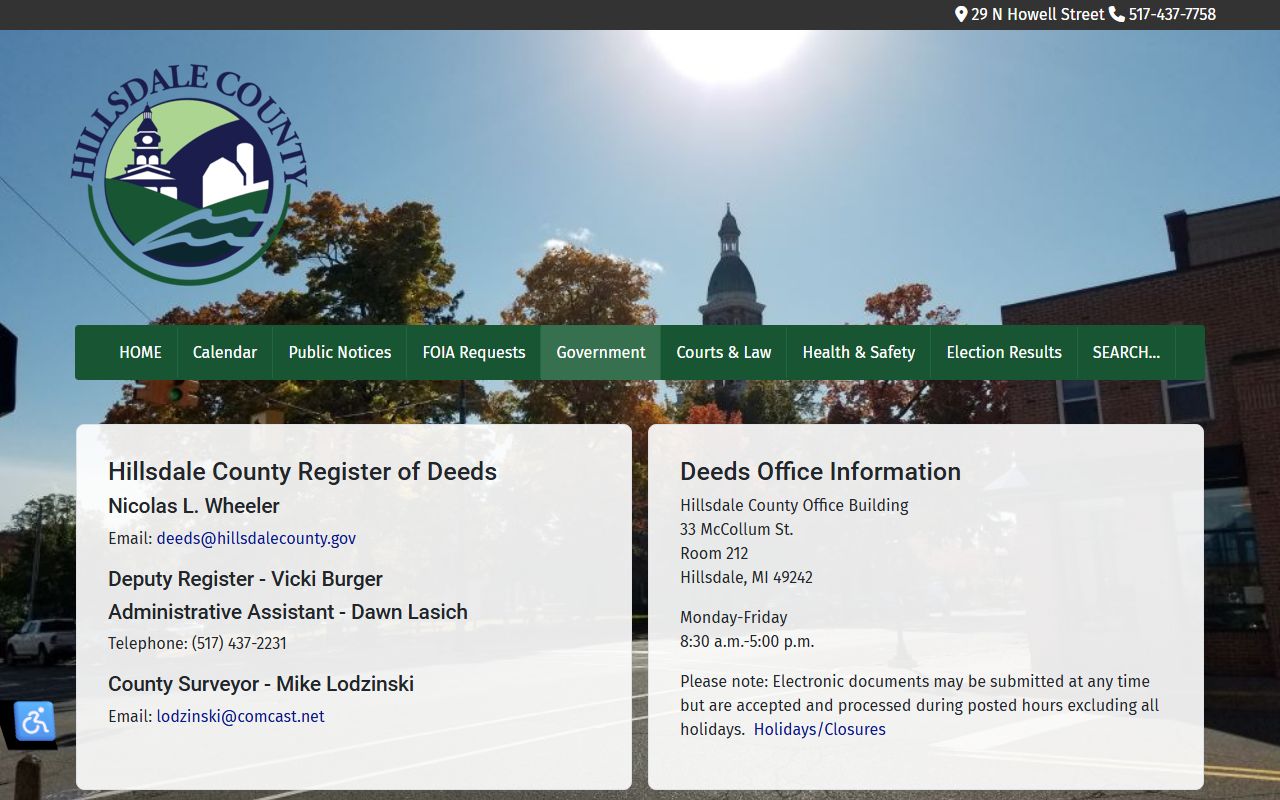
The page includes links to both the cloud-based and legacy search systems, making it easy to look up recorded documents in Hillsdale County without visiting the office in person.
Recording Fees and Search Fees
The recording fee is $30 per document. This flat rate applies to all recorded instruments under MCL 600.2657. It does not change based on page count. The fee has been in effect statewide since October 1, 2016.
Copies are $1.00 per page. A certified copy requires an additional $5.00. In-person grantor and grantee searches have a minimum fee of $5.00. Tax certificates are $5.00 for up to five legal descriptions and $0.20 for each description beyond five.
Remember: personal checks are not accepted. Bring certified funds. Cashier's checks and money orders are the standard options. If you are unsure of the exact amount needed, call 517-437-2231 before your visit or before sending a mail request. Getting the payment wrong will delay your transaction.
Transfer Tax in Hillsdale County
Michigan imposes a transfer tax on real estate sales. The state rate is $3.75 per $500 under MCL 207.521. Hillsdale County adds $0.55 per $500 under MCL 207.501. Together, the total is $8.60 per $1,000 of the sale price.
The seller typically pays this tax. A valuation affidavit is required for any deed conveying property for value. This form states the sale price and is filed with the deed at the time of recording. The office will not record a deed without it when a sale price is involved.
Hillsdale County's website includes a transfer tax calculator. This tool lets buyers and sellers estimate the tax before closing. Use it to confirm the amount is correct before you go to record. The calculator is available through the Register of Deeds section at co.hillsdale.mi.us.
Certain transfers qualify for a tax exemption. Transfers between spouses, some parent-child conveyances, and government-related transfers may be exempt. Note any exemption on the deed and attach the correct affidavit. An attorney or title company can confirm exemption eligibility before you record.
Document Formatting Requirements
All documents recorded in Hillsdale County must meet the standards in MCL 565.201. Non-compliant documents will be returned unrecorded.
The first page must have a 2.5-inch blank top margin. All other margins must be at least 0.5 inches. Use at least 10-point font. The first page must include: document type, names of all parties, complete legal description, mailing address for tax statements, and the preparer's name. If any of these items are missing, the document will be rejected.
Review formatting before the document is signed and notarized. Correcting a problem after signing requires either re-executing the document or, in some cases, filing a corrective affidavit. It is much easier to get it right before signing. Ask a title company or attorney to review the document if you are unsure.
The Hillsdale County government website gives access to county offices, including the Register of Deeds, Equalization, and Treasurer, all of which handle records and services related to property ownership.

Through the county site, property owners can also access the Equalization office for assessment questions and the Treasurer for tax payment information, both of which relate closely to deed and title matters.
Online Search Options in Hillsdale County
Hillsdale County offers two ways to search recorded documents online. The cloud version uses full-text OCR technology, which allows searches by any text found within the document. This is more powerful than a basic name search and can be useful when you know a legal description, parcel number, or other text from the document but not the exact party names.
The previous version uses more traditional search fields: grantor name, grantee name, date range, or liber and page number. This version works well if you know the parties involved or have a prior title search to reference. Both versions are linked from the Register of Deeds page at co.hillsdale.mi.us.
Online searches do not replace a formal title search. For real estate transactions, always work with a licensed title company or attorney. The online system is a tool for quick lookups, but a thorough title search requires examining the full chain of ownership and all recorded instruments that could affect title.
E-Recording and Property Fraud Alert
Hillsdale County accepts e-recorded documents through approved vendors. E-recording is authorized under MCL 565.841. Vendors include Indecomm, ePN, Simplifile (1-800-460-5657), and CSC. You must enroll with a vendor before submitting electronically. Each vendor charges its own service fee in addition to the county recording fee.
Property Fraud Alert is a free service available to all Hillsdale County property owners. You register your name, and the system sends you an email whenever a document is recorded under that name in the county. This early warning can alert you to fraudulent deed filings before the problem gets worse. Sign up through the county website or ask the Register of Deeds office for details.
Michigan is a race-notice state. The first party to record a deed, without prior knowledge of an earlier unrecorded claim, generally holds the stronger title. Recording your deed right after closing protects your ownership. Do not delay. A signed but unrecorded deed is vulnerable if someone else records first.
Property Transfer Affidavit
After any deed is recorded in Hillsdale County, the buyer must file a Property Transfer Affidavit with the local assessor within 45 days. This is required under Michigan law for all taxable property transfers.
The affidavit tells the assessor that the property changed hands. It triggers a review of the property's taxable value. Michigan caps taxable value growth while a property stays with the same owner. A sale lifts that cap. The assessor uses the affidavit to reset the taxable value for the next tax year. Failure to file on time results in a penalty of $5 per day, up to $200.
File the affidavit with the assessor of the township, city, or village where the property is located. The Register of Deeds does not handle this filing. Ask the local assessor's office for the correct form and any specific instructions.
Nearby Counties
Hillsdale County is in southern Michigan and shares borders with several other counties, each maintaining their own deed records.