
Jackson County Deed Records Search
Jackson County deed records are maintained by the Register of Deeds on the 12th floor of the county building in downtown Jackson, covering property transfers, mortgages, liens, and land documents from 1800 to the present day. The office provides grantor and grantee name search access online, along with a free Property Alert Notification service that emails you when a new document is recorded against your name or parcel.
Jackson County Deed Records
Jackson County Register of Deeds Office
The Register of Deeds is located at 120 W. Michigan Ave, 12th Floor, Jackson, MI 49201. Office hours are Monday through Friday, 8 AM to 4 PM. Unlike many Michigan counties, the Jackson office stays open during the lunch hour. You can reach the office at 517-788-4350 or by fax at 517-788-4686.
The office records all property-related instruments for Jackson County, including warranty deeds, quitclaim deeds, land contracts, mortgages, discharge of mortgage, liens, easements, and subdivision plats. Each document receives a unique recording number and timestamp when accepted, which establishes its place in the priority chain under Michigan's race-notice recording law.
The county's Register of Deeds page is available at co.jackson.mi.us. That page lists current fees, contact details, and links to the online search tool.
The screenshot below shows the Jackson County Register of Deeds page on the county website, where you can access the online search portal and find contact information for the office.
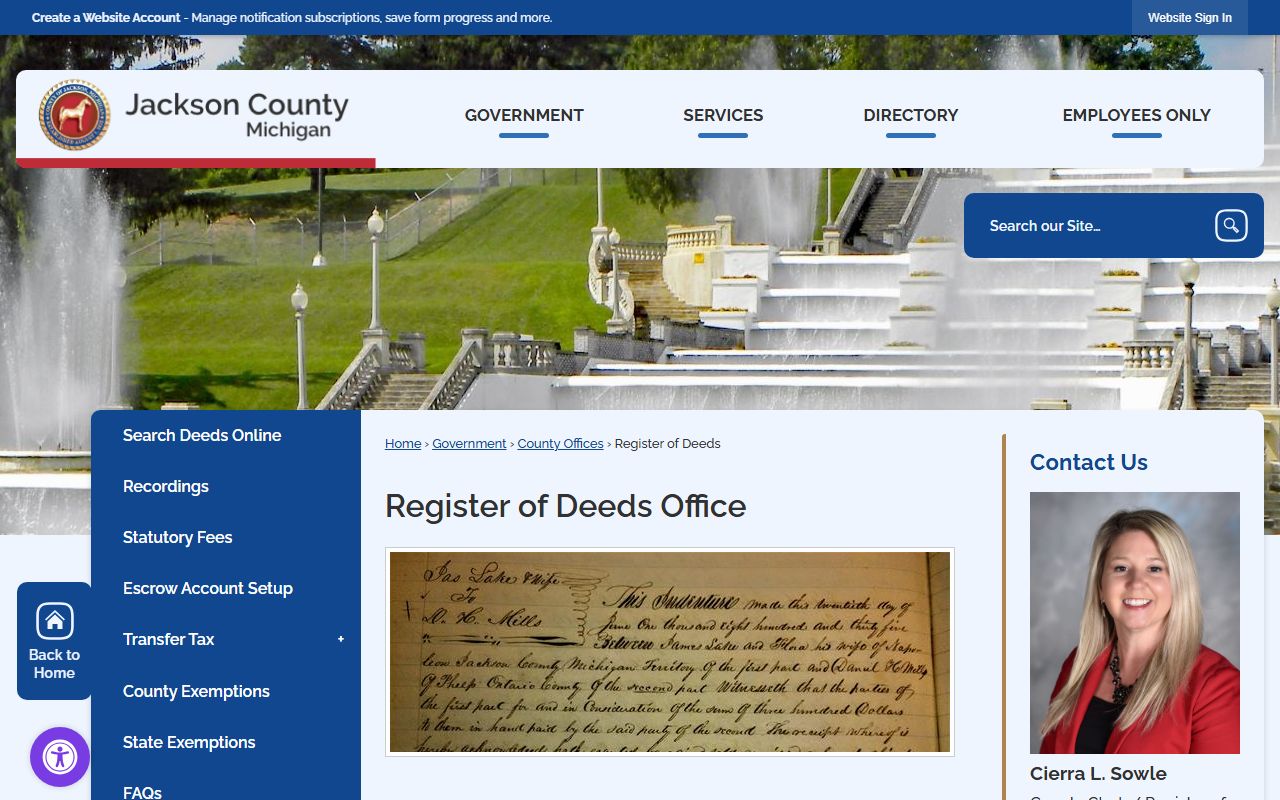
The department page gives you direct access to the online search system and lists all current recording fees and requirements for documents submitted to the office.
Online Record Search
Jackson County offers grantor and grantee name search online. You can look up recorded documents by party name to find deeds, mortgages, and other instruments tied to a specific person or entity. The digital index covers deeds and mortgages from 1800 to the present, making it one of the more complete online indexes in Michigan.
For title search work, the online system lets you pull the full chain of title without a trip to the courthouse. You can view document images, confirm recording dates, and download copies for your file. This is useful for attorneys, real estate agents, title examiners, and any property owner who wants to verify what is on record.
The second screenshot below shows the broader Jackson County government website, which provides additional context for county offices and services.
From the main county site you can navigate to related offices such as the Treasurer and Equalization departments, which maintain tax records that complement the deed index at the Register of Deeds.
Property Alert Notification Service
Jackson County offers a free Property Fraud Alert program. You sign up with your name and the county will email you whenever a new document is recorded under that name. This service is designed to catch fraudulent deeds or mortgages filed in your name without your knowledge.
Property fraud is a growing problem. Fraudsters sometimes record fake deeds transferring title to vacant properties or paid-off homes, then use the fraudulent deed to secure loans. The Property Alert service gives you early notice so you can act quickly. Registration is free and takes only a few minutes through the county website.
This alert covers all document types recorded at the Register of Deeds, not just deeds. So if someone files a lien or mortgage against your name, you get notified of that too. It is a simple and free way to monitor your property records.
Recording Fees and Transfer Tax
The flat recording fee in Jackson County is $30 per document under MCL 600.2657. This fee does not change based on page count or document length. Copy fees are $1.00 per page, and certified copies require an additional $5.00 certification fee on top of the per-page copy cost.
Real estate transfer tax is due on any deed that transfers property for consideration. The state collects $3.75 per $500 of value. The county adds $0.55 per $500. Combined, the total is $8.60 per $1,000 of sale price. A valuation affidavit must accompany every deed. This affidavit states the full consideration paid and is used to calculate the transfer tax owed at recording.
Jackson County also allows accounts to be set up for escrow-style pre-payment. Law firms or title companies that record frequently can deposit funds in advance and have fees deducted per transaction. This speeds up the recording process, especially for e-recording submissions where payment is required at the time of upload.
Document Requirements
MCL 565.201 governs document formatting for all instruments recorded in Michigan. A 2.5-inch top margin is required on the first page, with at least 0.5-inch margins on all other sides and on subsequent pages. The preparer's name and address must appear on the document, along with the name and address of the person to whom the recorded document should be returned.
Every deed must include the full legal description of the property. It must also show the tax parcel identification number. The consideration or the basis for any claimed transfer tax exemption must appear in the document or the accompanying valuation affidavit. Documents that do not meet these requirements will be rejected at the counter or returned by mail if submitted remotely.
Non-conforming documents may be accepted for a higher fee in some cases, but it is better practice to correct the document before submitting. The Register of Deeds office staff can tell you what is missing, but they cannot prepare documents or give legal advice. An attorney or title professional can help ensure your deed meets all state requirements.
E-Recording Options
Jackson County participates in Michigan's e-recording program under MCL 565.841, the Michigan Uniform Real Property Electronic Recording Act (MURPERA). This law allows counties to accept electronically submitted documents through approved vendors, which have the same legal effect as paper recordings.
Approved e-recording vendors include Simplifile (1-800-460-5657), ePN, CSC, and Indecomm. These platforms let title companies and closing agents upload documents directly from their office software and submit them to the county for recording. Payment is collected through the vendor at the time of submission. Most e-recorded documents are processed and returned the same day.
E-recording reduces the risk of lost documents and speeds up the closing process. For attorneys or companies that handle a high volume of recordings, setting up an e-recording account and an escrow pre-payment account with the county makes the process even smoother.
Michigan as a Race-Notice State
Michigan uses the race-notice recording system. Under this rule, a later buyer who pays value and records first wins over an earlier unrecorded transfer, provided the later buyer had no actual knowledge of the prior deed. This makes prompt recording essential after any property closing.
For sellers and buyers alike, the recording date is the legal moment of transfer in the public record. A deed signed but not recorded gives the grantee no protection against subsequent claims. Title insurance companies conduct their searches at the Register of Deeds to verify the chain of title and confirm that no competing claims appear in the recorded index.
Jackson County's online index lets you confirm the recording date and document number for any instrument in the public record. This is useful when you need to verify that a prior deed, discharge, or lien release was properly recorded before proceeding with a new transaction.
Nearby Counties
Jackson County is surrounded by several counties with their own Register of Deeds offices for property records access.