
Livingston County Deed Records
Livingston County deed records are filed with the Register of Deeds at 200 E. Grand River in Howell, where the office records all real property instruments for this fast-growing southeast Michigan county, including warranty deeds, quitclaim deeds, mortgages, and liens, with online search access available through the county's web portal. The office can be reached by phone at 517-546-0270, by fax at 517-546-5966, or by email at rod@livgov.com.
Livingston County Deed Records
Livingston County Register of Deeds Office
The Register of Deeds is located at 200 E. Grand River, Howell, MI 48843. Phone is 517-546-0270, fax is 517-546-5966, and the email is rod@livgov.com. The county ROD website is at milivcounty.gov/rod.
The office records all instruments affecting title to real property in Livingston County. This includes warranty deeds, quitclaim deeds, land contracts, mortgages, mortgage discharges, liens, easements, plats, and condominium documents. Each instrument is indexed by grantor and grantee name and assigned a recording number and timestamp at the moment of acceptance.
Livingston County sits between Oakland County and Ingham County and has grown significantly as a suburban and exurban county over recent decades. The volume of real property transactions recorded here reflects that growth, and the office processes a large number of deed recordings each year.
Michigan Treasury guidance on property ownership changes applies to every deed recorded in Livingston County. The screenshot below shows the state's Change of Ownership resource, which covers when a property transfer triggers a taxable value uncap and what must be filed alongside the deed.
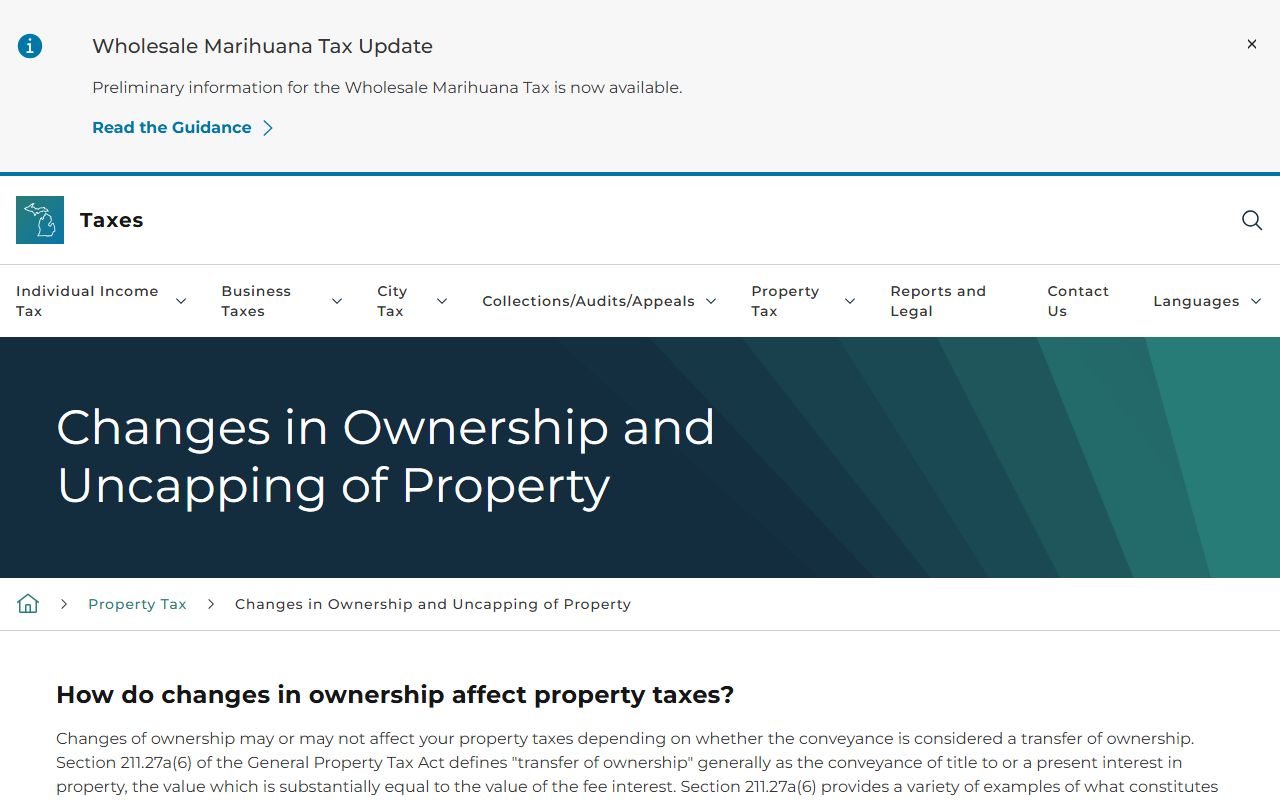
Livingston County buyers should pay close attention to this state guidance because many properties in the county have been capped at taxable values well below true market value, meaning a sale will trigger a significant property tax adjustment in the year following the deed recording.
Online Record Search
Livingston County provides online access to its deed index. You can search by grantor or grantee name to find deeds, mortgages, and other recorded instruments. The digital index covers the modern recording era and includes document images for instruments in the system. This lets you review the actual deed language, legal descriptions, and recording stamps without visiting the courthouse.
For research on older properties, in-person access to older index volumes and microfilm may be required for records that predate the digital system. Staff at the office can assist with older index searches during regular business hours. Call ahead if you plan to research records from before the digital era so the office can prepare for your visit.
The online search tool is useful for attorneys, title companies, real estate agents, buyers, and sellers who want to check the chain of title on a Livingston County property without traveling to Howell. You can confirm ownership, check for recorded liens, and verify that prior deeds and discharges appear correctly in the public record.
Recording Fees and Copy Costs
The recording fee in Livingston County is $30 per document, set by state statute under MCL 600.2657. This flat fee applies to every instrument submitted for recording, regardless of page count or document length. Copy fees are $1.00 per page for standard copies. Certified copies add a $5.00 certification fee on top of the per-page copy cost.
Real estate transfer tax must be paid when a deed is recorded. The state levies $3.75 per $500 of consideration and the county collects $0.55 per $500, for a combined rate of $8.60 per $1,000. A valuation affidavit is required with every deed. It must disclose the full consideration paid or state the specific legal basis for claiming a transfer tax exemption.
Livingston County property values have risen considerably over the past two decades. On a typical county home sale in the $300,000 to $400,000 range, the transfer tax runs between $2,580 and $3,440. Buyers and sellers both benefit from knowing this cost before closing. In Michigan practice, the seller typically pays the transfer tax, but this can be negotiated in the purchase agreement.
Document Formatting Requirements
MCL 565.201 sets the minimum formatting standards for documents recorded in Michigan. The first page must have a 2.5-inch blank margin at the top for the county's recording stamp. All other margins must be at least 0.5 inches. Body text must be at least 10-point type. These requirements are uniform across all 83 Michigan counties.
The deed must name the preparer and include their address. The name and return address for the recorded document must appear on the first page. The tax parcel identification number must be listed for each parcel in the legal description. The legal description itself must be complete and match the parcel as it appears in the county records. Documents that do not meet these standards will be rejected at the counter or returned if submitted by mail.
The Register of Deeds office does not draft documents, correct errors, or advise on legal matters. If your deed is rejected, you will need to work with an attorney or title professional to identify and fix the problem. Getting the document right before you submit saves time and avoids the cost of a re-filing or a follow-up corrective deed.
E-Recording Under MURPERA
Livingston County accepts electronically submitted documents under MCL 565.841, the Michigan Uniform Real Property Electronic Recording Act. This law gives electronically recorded documents the same legal standing as paper instruments filed in person or by mail.
Approved e-recording vendors include Simplifile (1-800-460-5657), ePN, CSC, and Indecomm. Title companies and closing agents use these platforms to submit documents digitally and receive confirmation of recording without visiting the courthouse. The $30 per document fee and any required transfer taxes are collected through the vendor at the time of submission. Most e-recorded documents are processed and returned the same business day.
For high-volume users, the speed and convenience of e-recording is significant. In a market like Livingston County, where dozens of closings may happen on a single day, e-recording reduces the backlog at the counter and gets deeds into the public record faster. This protects buyers and lenders who depend on prompt recording under Michigan's race-notice law.
Race-Notice Recording and Why It Matters
Michigan is a race-notice state. The rule is straightforward. If two people both claim rights to the same property, the one who records first wins, as long as that person paid value and had no actual knowledge of the competing prior claim at the time of purchase. This rule applies to deeds, mortgages, and other recorded instruments.
A deed that is signed but sitting in a file drawer is not in the public record. It protects no one against a later buyer or lender who records first. For a county like Livingston, where the real estate market is active and properties change hands frequently, recording your deed immediately after closing is essential. Even a one-day delay creates a gap in the public record that could matter in a disputed transaction.
Delinquent tax information is another layer of property research relevant to Livingston County buyers. The Michigan Treasury document below covers delinquent tax revolving fund rules, which affect properties carrying unpaid back taxes that may appear as encumbrances in a title search.
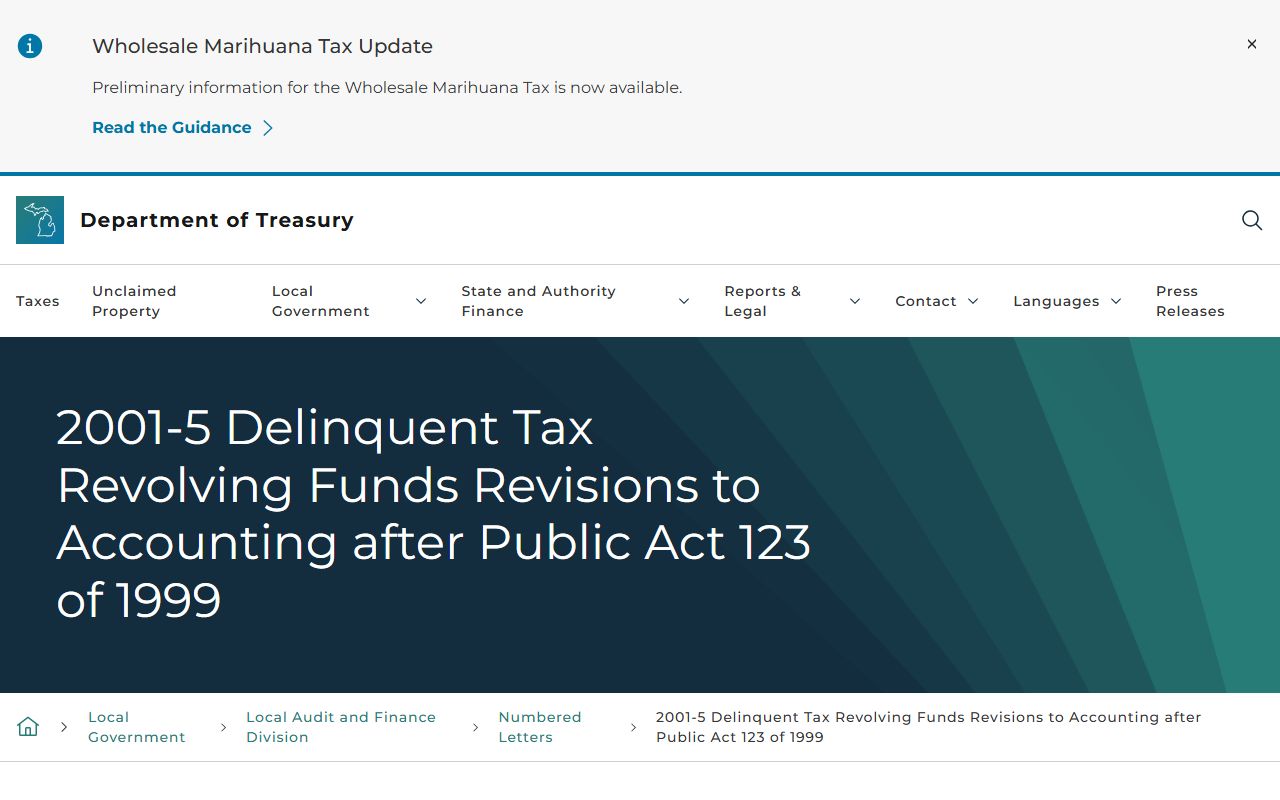
Checking both the deed index and the current tax status of a Livingston County parcel before closing gives buyers the most complete picture of the property's encumbrance history and current obligations.
Valuation Affidavit and Transfer Tax Exemptions
Every deed recorded in Livingston County must be accompanied by a real estate transfer tax valuation affidavit. The affidavit declares the consideration paid for the property. This figure is used to calculate the state and county transfer tax due at recording. Without the affidavit, the Register of Deeds will not accept the deed for recording.
If the transfer qualifies for a tax exemption, the affidavit must identify the specific statutory basis for that exemption. Common exemptions include transfers between spouses, transfers where the grantor is also the beneficiary of the transferee trust, and government conveyances. Even exempt transfers must be documented with the affidavit, as the form is required with every deed regardless of tax status.
Errors in the valuation affidavit can create problems down the road. An understated consideration amount may trigger a Michigan Department of Treasury audit. An incorrectly claimed exemption may result in back taxes and penalties. Getting the affidavit right from the start avoids these headaches. An attorney or title professional can prepare the affidavit correctly as part of the closing process.
Nearby Counties
Livingston County connects to several southeast Michigan counties, each with their own Register of Deeds for property records research.