
Midland County Deed Records Search
Midland County deed records are available online through multiple search platforms, including Tapestry EON, Laredo Anywhere, and Fidlar Technology, all of which draw on the county's indexed records from 1949 forward maintained by the Register of Deeds in the city of Midland. The office handles all real property filings for the county and is open Monday through Friday with extended hours compared to many Michigan counties, remaining open until 5:00 PM.
Midland County Deed Records
Register of Deeds Office Information
The Midland County Register of Deeds is located at 220 W. Ellsworth Street, Midland, MI 48640. The office is open Monday through Friday, 8:00 AM to 5:00 PM, which is later than many Michigan county offices. The phone number is 989-832-6820 and the fax is 989-832-6842. The official department page is at midlandcountymi.gov/register-of-deeds.
The Register of Deeds records all documents that affect title to real property in Midland County. Warranty deeds, quitclaim deeds, land contracts, mortgages, mortgage discharges, liens, easements, and plat documents are among the instruments recorded here. Midland County is home to Dow Chemical's global headquarters, which has historically influenced a robust commercial and industrial real estate market alongside residential property activity. The office processes a steady volume of both residential and commercial filings.
The screenshot below shows the Register of Deeds page at midlandcountymi.gov, the official portal for county government information and services.
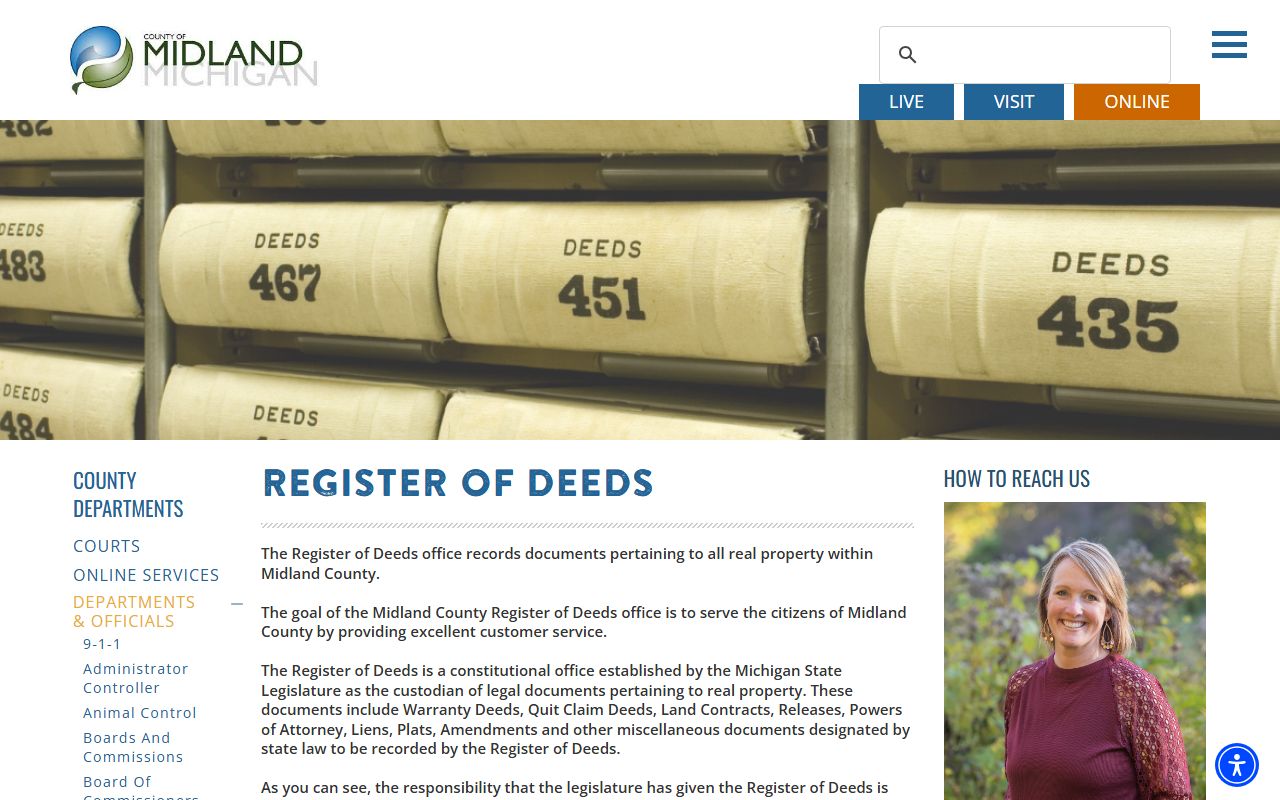
The department page provides links to online search platforms, recording requirements, fee schedules, and contact information for the office.
Online Search Platforms
Midland County deed records are accessible through three online platforms: Tapestry EON, Laredo Anywhere, and Fidlar Technology. Each platform may serve slightly different user needs. Tapestry and Laredo are widely used by title professionals in Michigan and offer robust search capabilities, document viewing, and download options, often with a subscription or per-search fee structure. Fidlar Technology is another established vendor in the Michigan Register of Deeds market.
The online index covers records from 1949 to present. For documents recorded before 1949, contact the Register of Deeds at 989-832-6820. Staff can search older grantor-grantee index books for records that predate the electronic index. Mail requests are accepted for older research with turnaround time dependent on the complexity and volume of the search. Plan accordingly if you need historical records going back many decades.
The image below shows the Midland County government website, which serves as the main access point for links to all county departments and online services including the deed records portals.

All links to online records platforms and department contact details can be found at midlandcountymi.gov.
Recording Fees and Transfer Tax
The recording fee in Midland County is $30 per document, set by state law under MCL 600.2657. This fee applies to the first page of a standard deed instrument. Copies of recorded documents cost $1.00 per page. Certified copies add a $5.00 certification fee on top of the per-page copy charge. Checks should be made payable to the Midland County Register of Deeds.
Michigan's real estate transfer tax applies to most deed recordings at a combined rate of $8.60 per $1,000 of the property sale price. The breakdown is $3.75 per $500 for the state tax and $0.55 per $500 for the county tax. The seller typically pays the transfer tax at closing. A valuation affidavit must accompany the deed when it is submitted for recording to document the consideration paid. Transfers exempt from the tax include sheriff's deeds, some family transfers, and certain transactions where no money changes hands. If you believe your deed qualifies for an exemption, indicate the exemption basis clearly on the affidavit.
Document Formatting Standards
Documents submitted for recording must comply with MCL 565.201. Paper must be white, 8.5 by 11 or 8.5 by 14 inches. The first page needs a 2.5-inch top margin for the recording stamp. All other margins must be 0.5 inches or wider. Print must be black, readable, and at least 10-point font size.
The deed must include the full legal name of the grantor and grantee, the legal description of the property, the name and address of the person who prepared the document, and the name and address of the person to whom the recorded document should be returned. All grantors must sign before a notary public. Incomplete or improperly formatted documents will be returned unrecorded. If you are preparing a deed yourself without an attorney, it is worth having a title company or the office review your formatting before you submit to avoid rejection and re-recording delays.
E-Recording in Midland County
Midland County accepts electronic recording submissions under Michigan's MURPERA statute at MCL 565.841. E-recording is particularly practical for title companies, banks, and law firms that handle frequent real estate closings in mid-Michigan. Documents submitted electronically are processed faster than mail submissions and return recording confirmation without the delay of physical delivery.
Approved e-recording vendors in Michigan include Simplifile (1-800-460-5657), ePN, CSC, and Indecomm. The office at 989-832-6820 can confirm which vendors are currently accepted and whether there are any specific requirements for e-submissions in Midland County. For those who record documents only occasionally, in-person or mail submission remains straightforward. The office's extended hours until 5:00 PM give more flexibility for in-person drop-offs than most county offices offer.
Michigan Race-Notice Recording Law
Michigan is a race-notice recording state. If two parties have competing claims to the same property, the one who records first wins, provided that party had no prior notice of the other claim. Recording your deed promptly after closing is not optional if you want full legal protection of your ownership rights.
The Register of Deeds assigns each document a recording date, time, liber, and page number upon receipt. That timestamp establishes your priority in the county's public record. Title searches in Midland County use the recorded index to identify all instruments affecting a parcel, and title insurance policies are issued based on what the index reveals. Any unrecorded deed or claim is legally subordinate to a later recorded instrument held by someone without notice of the prior claim. Record promptly and keep your recorded deed in a safe place for future reference.
Nearby Counties
Midland County sits in the middle of Michigan's Lower Peninsula and shares borders with Bay, Saginaw, Isabella, Gladwin, and Clare counties.