
Search Isabella County Deed Records
Isabella County deed records are filed with the Register of Deeds in Mount Pleasant, where you can search land transfers, mortgages, liens, and other property documents going back to the mid-1800s. The office provides both an online Land Record Search portal and an in-person Document Search portal, giving residents and researchers several ways to access recorded property instruments.
Isabella County Deed Records
Isabella County Register of Deeds
The Register of Deeds office is located at 200 N. Main Street, Room 220, Mount Pleasant, MI 48858. Office hours run Monday through Friday, 8:00 AM to 4:30 PM, with a lunch closure from noon to 1:00 PM. You can reach the office by phone at 989-317-4089, by fax at 989-953-7219, or by email at registerofdeeds@isabellacounty.org.
The office maintains the official index of all real property instruments recorded in Isabella County. This includes warranty deeds, quitclaim deeds, land contracts, mortgage documents, liens, easements, plats, and discharge records. Every document submitted must meet the formatting requirements set under Michigan law before the office will accept it for recording.
Visit the official department page at isabellacounty.org for current forms, fee schedules, and news from the office.
Online Search Options
Isabella County offers two online portals for searching deed records. The Land Record Search portal and the Document Search portal both let you look up instruments by name or document type. Search access is priced at 50 cents per year searched, with a minimum charge of $5.00. That minimum covers 10 years of search history, so short date-range queries are included at the base rate.
To use the online system, you will need to set up a prepaid account with the county. The search tool lets you pull grantor and grantee indexes, view document images, and download or print copies for your records. This is useful for title researchers, attorneys, real estate agents, and property owners who want to check the chain of title from home.
The Michigan Treasury has published guidance on property ownership changes that applies across all 83 counties. The screenshot below shows the state's Change of Ownership resource page, which explains when a transfer triggers a taxable value uncap and what documents must accompany a deed filing.
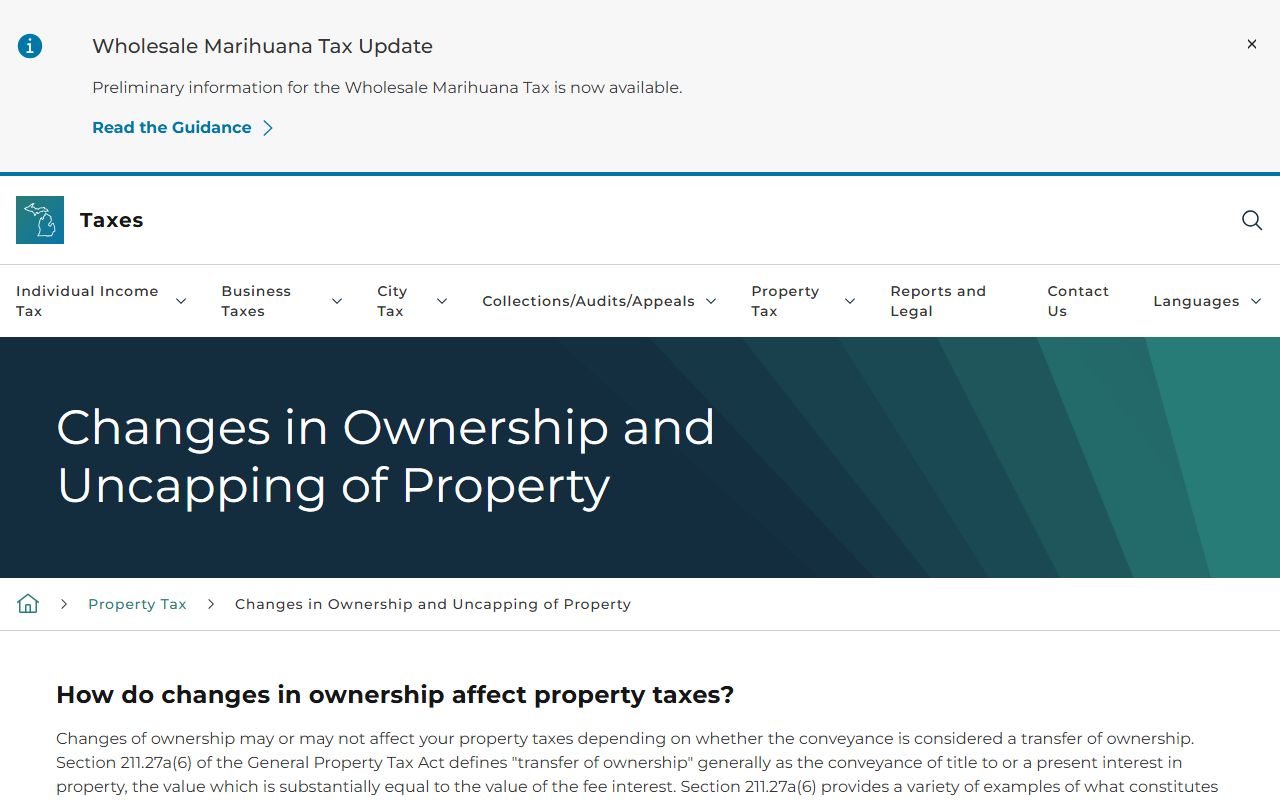
Reviewing this state guidance before filing a deed can help you avoid delays caused by missing affidavits or incorrect transfer tax calculations at the Isabella County Register of Deeds office.
Recording Fees and Costs
Michigan sets a flat $30 recording fee per document under MCL 600.2657. This fee applies to every instrument submitted for recording, regardless of the number of pages. Copy fees are $1.00 per page, and certified copies cost an additional $5.00 certification fee. Tax certificates in Isabella County are $5.00 for up to five property descriptions.
The real estate transfer tax has two parts. The state portion is $3.75 per $500 of value. The county portion adds $0.55 per $500. Together, those come to $8.60 per $1,000 of sale price. So on a $200,000 property sale, the total transfer tax would be $1,720. Both the state and county portions are due at the time of recording.
Certain transfers are exempt from the real estate transfer tax. These include transfers between spouses, transfers to a trust where the grantor is the beneficiary, and some transfers at or below a certain value threshold. If your deed qualifies for an exemption, you still need to file a transfer tax valuation affidavit explaining the basis for the exemption.
Document Requirements Under Michigan Law
MCL 565.201 sets out the formatting rules that every deed and mortgage must follow before the Register of Deeds will accept it. Key requirements include margins of at least 2.5 inches at the top of the first page and at least 0.5 inches on all other sides. The document must identify the drafter, include the return address for the recorded instrument, and state the tax parcel identification number for all property described.
Font size must be at least 10-point type throughout the body of the document. The legal description of the property must be complete and accurate. Deeds that reference a prior recorded document should include the liber and page number or the document number from the county index. Failure to meet these standards can result in rejection at the counter or additional fees for non-conforming documents.
The Michigan Treasury also provides guidance specifically on easement conveyances and how transfer tax applies in those situations. The screenshot below shows that resource page.
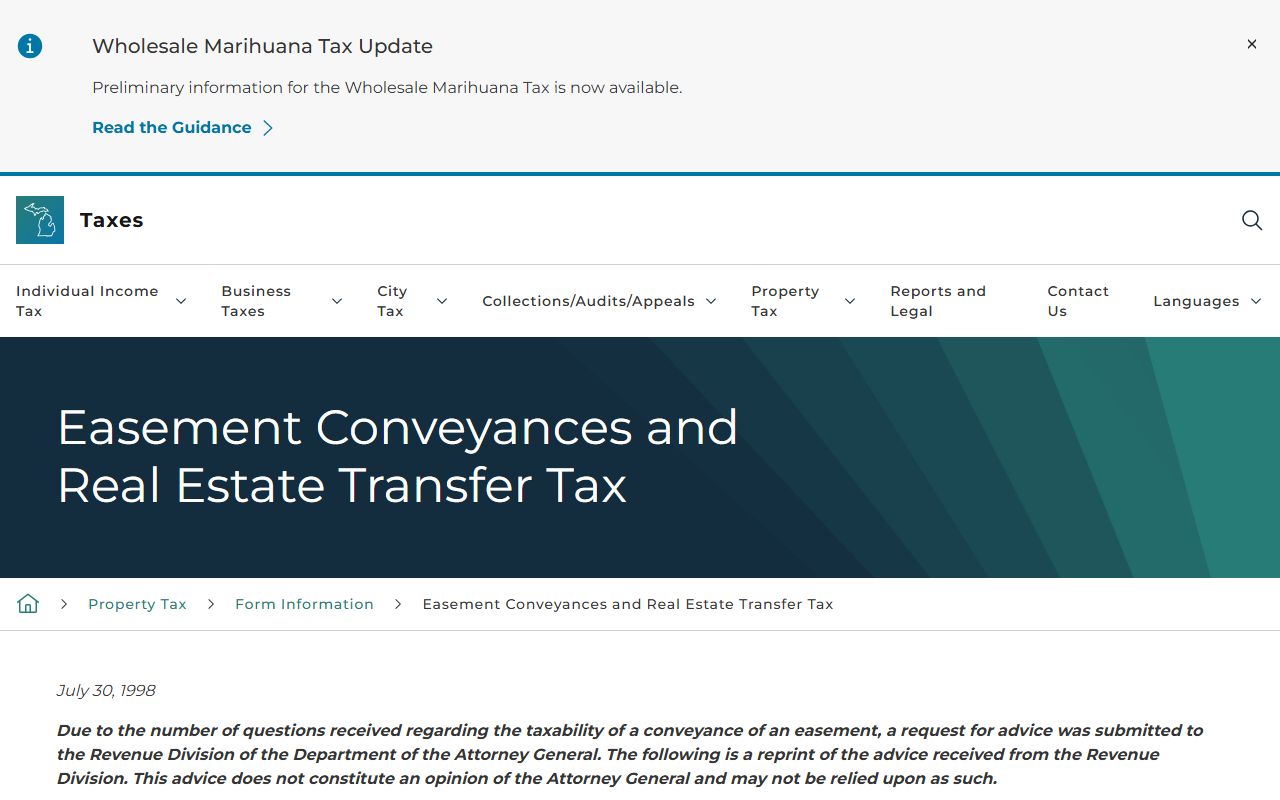
If you are recording an easement in Isabella County, reviewing this state guidance will help you determine whether the conveyance is taxable and what valuation affidavit language to use.
E-Recording in Isabella County
Isabella County accepts documents submitted through electronic recording vendors. E-recording lets title companies, attorneys, and settlement agents send documents digitally rather than by mail or in person. The legal authority for Michigan e-recording comes from MCL 565.841, known as MURPERA, which governs electronic recording statewide.
Approved vendors include Simplifile (1-800-460-5657), ePN, CSC, and Indecomm. These platforms integrate with most closing software used by title companies. Documents submitted via e-recording receive the same legal effect as paper filings. The $30 per document fee still applies, and transfer taxes are collected through the vendor platform at the time of submission.
E-recording is faster than mail. Most documents submitted electronically are recorded and returned the same day. This matters in real estate closings where buyers and sellers need the deed recorded quickly to close out escrow and confirm transfer of title.
Historical Records
Isabella County deed records go back to the mid-1800s. These older instruments were recorded in bound liber volumes before the county moved to digital indexing. Researchers working on chain-of-title searches or genealogical projects may need to work with both the digital index and the older microfilm or paper volumes held at the office.
The office staff can help you navigate the indexing system for older records. When searching historical deeds, it helps to know the approximate date of the transaction, the names of the grantor or grantee, and a general description of the land, such as a section, township, and range reference. Older deeds often use metes-and-bounds descriptions rather than lot and block references.
Delinquent tax records are a related resource for property research. The Michigan Treasury letter below covers delinquent tax revolving fund rules, which affect properties with unpaid taxes that may appear in the deed chain.
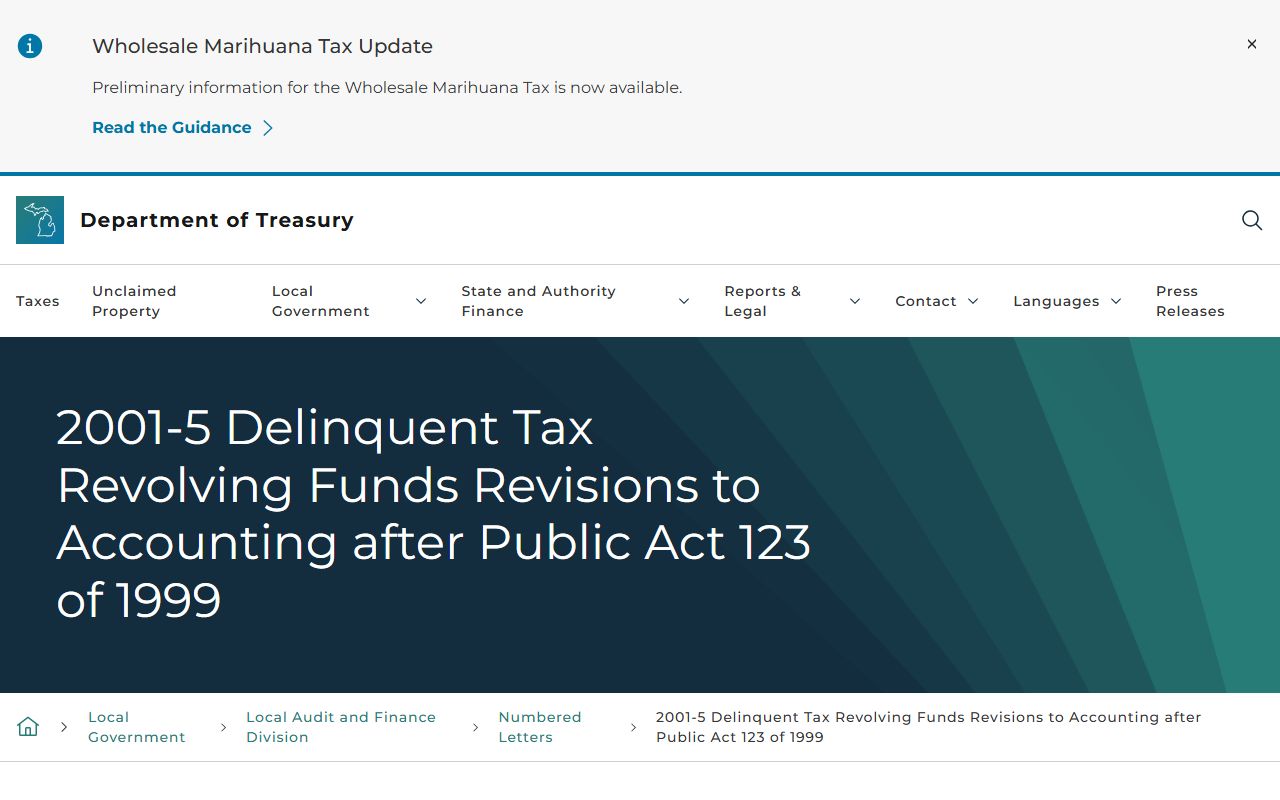
Checking delinquent tax status alongside deed records gives a fuller picture of any encumbrances that may affect clear title to Isabella County property.
Race-Notice Recording and Why It Matters
Michigan is a race-notice state. This means that when two parties both claim rights to the same property, the one who records first and without knowledge of any prior unrecorded claim generally wins. Recording your deed promptly after closing is not just good practice. It is legally important. A deed held in a drawer but not recorded gives you no protection against a subsequent buyer who records first and has no knowledge of your prior claim.
For lenders, this same rule applies to mortgages. A mortgage recorded before a competing lien has priority over that lien, subject to the same good-faith requirements. Title insurance companies rely on the recorded index at the Register of Deeds to determine priority and issue coverage. Any gap in the recording chain creates risk.
The Register of Deeds office date-stamps and assigns a document number to each instrument at the moment of recording. That timestamp establishes your place in the priority chain. Both the grantor-grantee index and the document number are public record and searchable through the county's online portal.
Nearby Counties
Isabella County borders several mid-Michigan counties, each with its own Register of Deeds office for property records research.