
Search Oscoda County Deed Records
Deed records in Oscoda County are filed with the Register of Deeds office in Mio, which maintains the official index and archive of all property instruments recorded within the county, including warranty deeds, quitclaim deeds, mortgages, land contracts, easements, and other documents that affect title to real property. These records are public and can be searched by anyone who needs to look into ownership history, check for encumbrances, or verify that a prior lien has been released on a specific parcel in Oscoda County.
Oscoda County Deed Records
Oscoda County Register of Deeds Office
The Register of Deeds office is located at 301 W. Morenci Ave., P.O. Box 399, Mio, MI 48647. Phone: 989-826-1110. The county website is at oscodacountymi.com. Office hours can be confirmed by calling ahead or checking the county website. For mailed document submissions, use the P.O. Box address. For in-person visits, go to 301 W. Morenci Ave.
Oscoda County is one of Michigan's smaller counties by population, located in the northeastern Lower Peninsula. The Register of Deeds here handles all the same types of instruments as any other Michigan county, including deeds, mortgages, easements, plats, land contracts, and discharge documents. Despite the county's small size, the land records go back well over a century, and the office maintains those historic records along with current filings.
When you submit a document, staff will check that it meets state requirements before recording it. If anything is missing or out of standard, the document will be returned. Calling 989-826-1110 before making the trip is a good idea if you have questions about what the office needs.
The image below from the Michigan Treasury shows change-of-ownership guidelines that govern all Michigan property transfers, including those in Oscoda County.
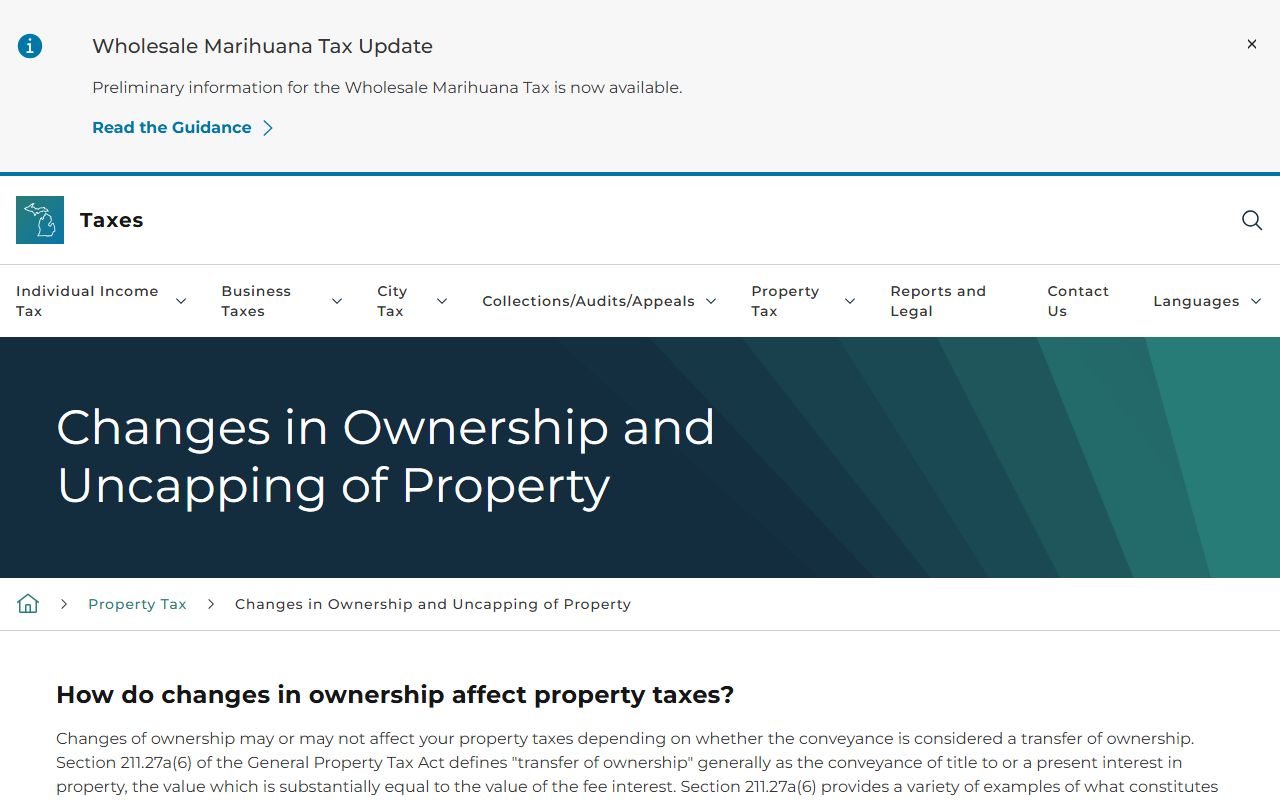
These statewide guidelines explain the property transfer affidavit requirement that accompanies every deed recording and must be filed with the local assessor.
Recording Fees in Oscoda County
The recording fee for most documents in Michigan is $30, established by MCL 600.2657. This flat fee applies to deeds, mortgages, discharges, assignments, and most other instruments filed with the Register of Deeds. The amount does not change based on the number of pages or the value of the property. Copies are $1 per page. Certified copies, needed for certain court filings and legal proceedings, cost $5 for the certification plus $1 per page.
When submitting by mail, include a check or money order for the recording fee made payable to the Oscoda County Register of Deeds. Include a self-addressed stamped envelope for return of the recorded document. Keep a copy of everything you send for your records. In-person payments can typically be made by check, cash, or money order depending on what the office accepts. Call ahead to confirm accepted payment methods.
Documents submitted with the wrong fee will be returned without recording. Check the fee before you send anything in.
Document Formatting Under MCL 565.201
All documents submitted for recording in Michigan must comply with MCL 565.201. The top margin on the first page must be at least 2.5 inches to allow space for the recording stamp and the register's notations. Margins on all other edges must be at least 0.5 inches on all pages. Text must be legible and printed in at least a 10-point font. The document must be on standard 8.5 x 11 inch paper and must be clear enough to scan and reproduce.
The first page must show the name and address of the person who prepared the document. It must also show the address where the property tax bill should be sent after recording. And it must include a complete legal description of the property. A street address alone is not a legal description in Michigan. The description must come from the county's records and should reference the metes and bounds, lot number, or section-township-range designation as appropriate for the parcel.
Documents that don't meet these standards will be returned. This can hold up a closing. Review your document carefully before you submit it.
Transfer Tax and Ownership Reporting
Michigan real estate transfer tax applies to most property sales in the state. The state rate is $3.75 per $500 of value. Oscoda County adds $0.55 per $500. The combined total is $8.60 per $1,000 of the sale price. The seller is responsible for paying this at closing. Tax is calculated on the actual sale price, not the assessed value.
In addition to the transfer tax, a property transfer affidavit must be filed with the local township or city assessor within 45 days of the closing date. This affidavit notifies the assessor that ownership has changed so they can update the tax rolls. Failing to file within 45 days results in a penalty. The affidavit is not filed with the Register of Deeds. It goes to the township assessor where the property is located.
Some transfers are exempt from transfer tax. Transfers between spouses, deed corrections, and certain government transfers qualify. If an exemption applies, note it on the face of the deed so the register can process the document without assessing the tax.
The image below shows Michigan Treasury information about delinquent taxes, which is relevant for Oscoda County buyers who need to check whether a property has unpaid tax obligations.
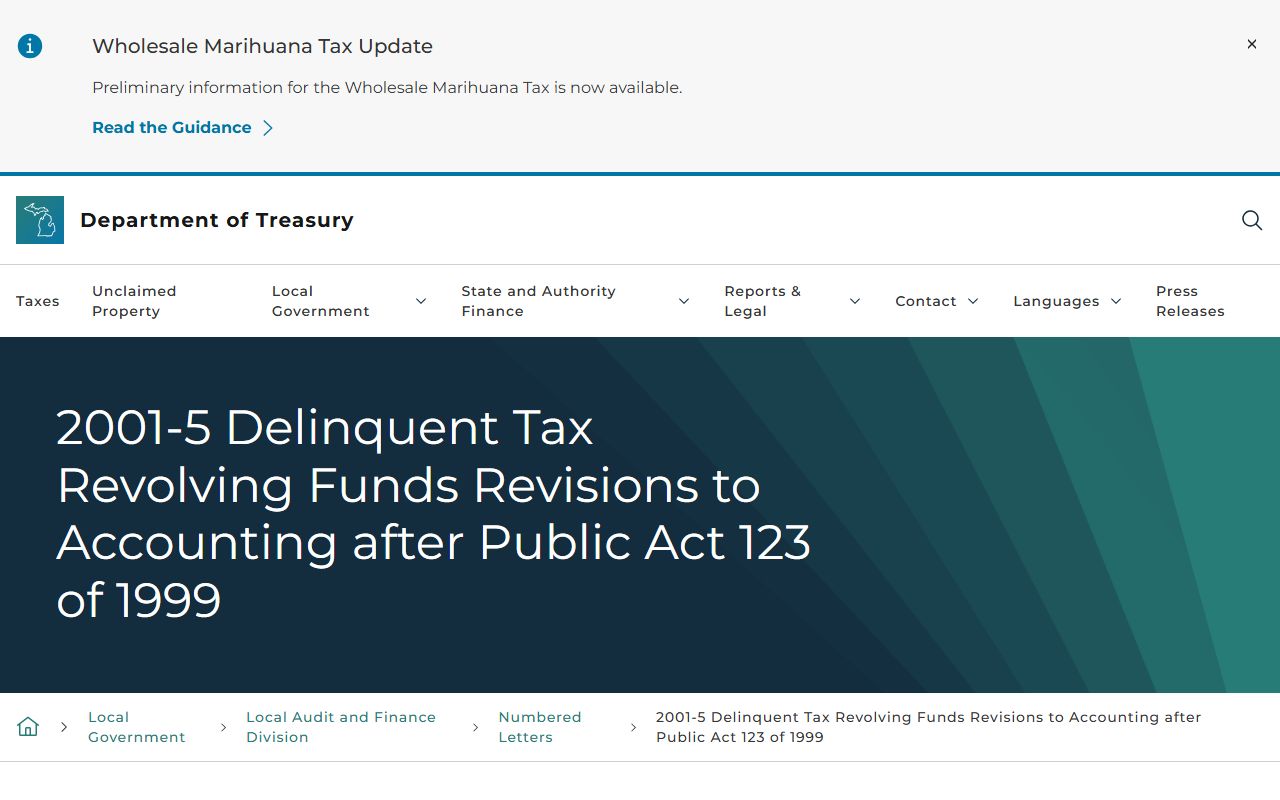
Delinquent property taxes in Michigan can become a lien on the property and may ultimately result in a tax foreclosure if left unpaid, so checking for outstanding tax debt before closing is important.
Property Deed Types in Oscoda County
Warranty deeds are the standard deed used in arm's-length sales. The seller warrants that the title is clear and that they have the right to convey. Quitclaim deeds transfer only the grantor's interest, whatever that may be, with no title covenants. These come up often in family transfers, divorce settlements, and estate distributions where the parties are not looking for the protection that a warranty provides.
Land contracts are not uncommon in rural areas like Oscoda County. A land contract is a seller-financed arrangement where the buyer takes possession and makes payments over time. Legal title stays with the seller until the final payment is made. Both parties benefit from recording the contract. The buyer's equitable interest is on the public record, which protects them if the seller tries to convey the property to someone else while the contract is still in force.
Mortgages, easements, deed restrictions, plats, and right-of-way grants are also recorded here. In an area with significant wooded and recreational land, easements for roads, trails, and utilities can be especially important to identify when looking at a parcel.
Michigan's Race-Notice Recording Rule
Michigan is a race-notice state. Under this doctrine, when two parties claim competing interests in the same property, the one who records first and who had no notice of the other's claim takes priority. This rule is what makes prompt recording so important. The moment you close on a property, you should have the deed recorded as quickly as possible.
E-recording through Michigan's MURPERA framework at MCL 565.841 makes same-day recording possible for title companies and lenders who use approved providers. Simplifile (1-800-460-5657), ePN, CSC, and Indecomm are among the approved e-recording services operating in Michigan. For closings handled by a title company, e-recording is usually built into the process. For private transactions, you may need to submit the deed in person or by mail.
Whether you record in person, by mail, or electronically, what matters is getting it done quickly. A deed sitting in a drawer is not recorded. It offers no protection against a later claimant who records first.
Nearby Counties
Oscoda County is located in the northern Lower Peninsula and shares borders with several other Michigan counties, each with its own deed recording office.