
Search Shiawassee County Deed Records
Shiawassee County deed records are kept at the Register of Deeds office in Corunna, where all property transfers, mortgages, liens, easements, and other land documents affecting real estate in the county are recorded and maintained as part of the permanent public record. The office serves property owners, title companies, attorneys, and lenders throughout the county and surrounding area.
Shiawassee County Deed Records
Shiawassee County Register of Deeds Office
The Shiawassee County Register of Deeds is at 208 N. Shiawassee St., Corunna, MI 48817. Call 989-743-2371 during business hours for help with recording, document searches, or copy requests. The county website at shiawassee.net provides contact information and may include office hours or guidance on services.
This office records all documents that create or affect an interest in real property in Shiawassee County. Common document types include warranty deeds, quitclaim deeds, mortgages, land contracts, mortgage discharges, easements, and judgment liens. Each document is indexed by grantor and grantee name and becomes part of the public record upon recording.
Shiawassee County sits in central Michigan between the Lansing metro area to the west and the Flint area to the east. The county is a mix of agricultural land, small cities, and residential neighborhoods. Owosso is the largest city, though Corunna serves as the county seat where the Register of Deeds office operates.
Recording Fees and Copy Costs
Shiawassee County charges a flat $30 recording fee for most documents. This applies to deeds, mortgages, releases, and other instruments. The fee is the same regardless of page count. It is set by state law under MCL 600.2657, which took effect October 1, 2016.
Copies are available for $1.00 per page. Certified copies include a $5.00 certification fee in addition to the per-page cost. You can get copies in person or by mail. Mail requests need the document details, your return address, and the correct payment amount.
Call the office before mailing to confirm current payment options and verify the document information you have. This saves time and avoids having your request sent back due to incorrect payment or missing details.
Real Estate Transfer Tax
Michigan charges a transfer tax on most real property sales. The state's share is $3.75 per $500 of the purchase price. Shiawassee County adds $0.55 per $500. The total comes to $8.60 per $1,000 of the sale price. The seller pays this in most standard transactions.
A valuation affidavit must be filed with any deed that transfers property for value. This form discloses the actual sale price so the correct tax can be calculated. The Register of Deeds will not record a taxable deed without it. Most title companies and real estate attorneys include this form as a routine part of the closing package.
Certain transfers are exempt from the transfer tax. These include transfers between spouses, transfers to or from government entities, and some foreclosure-related conveyances. Other exemptions exist for certain family transfers and charitable donations. If your transaction qualifies, note the exemption on the deed and attach the appropriate affidavit. Consult a title company or attorney if you are not sure whether an exemption applies.
Document Formatting Requirements
Michigan law at MCL 565.201 sets formatting standards for all recorded documents. The Shiawassee County Register of Deeds applies these rules and will reject documents that do not comply. There is no grace period for formatting errors.
The first page must have at least a 2.5-inch top margin. All other margins must be 0.5 inches or more. Font must be at least 10 points. The first page must state the document type, the names of all parties, the legal description of the property, and the name and address for tax statements. The name of the document preparer must also be included.
You can submit documents in person at the Corunna office, by mail, or electronically through an approved e-recording vendor. In-person submissions are typically processed the same day. Mailed documents take longer but are a workable option for routine filings. E-recording is the fastest option for high-volume filers.
After recording, the office stamps the document with the date, time, liber number, and page number. These stamped details become the official record of when and where the document was filed. Keep the stamped original in a safe place.
E-Recording in Shiawassee County
Shiawassee County accepts electronic recording through approved vendors. Title companies, lenders, and law firms can submit documents digitally without visiting the office. The vendor handles the submission, and the document is returned electronically after recording.
Approved vendors include Simplifile (1-800-460-5657), ePN, CSC, and Indecomm. Each vendor has its own enrollment process and fee structure. Contact the vendor of your choice to get started. The legal basis for e-recording in Michigan is the Michigan Uniform Real Property Electronic Recording Act at MCL 565.841.
The Michigan Treasury's guidelines on change of ownership reporting apply to every property transfer in Shiawassee County. The image below shows part of those state requirements.

After a deed is recorded in Shiawassee County, the buyer must file a Property Transfer Affidavit with the local assessor within 45 days of the transfer. Missing this deadline results in a penalty.
Searching Shiawassee County Deed Records
You can search deed records in person at the Register of Deeds office in Corunna. Staff can help you find documents by grantor or grantee name, liber and page number, or date range. Come prepared with as much detail about the property or parties as possible to speed up the search.
Check the county website at shiawassee.net for any available online search options. Access levels can change over time, so it is worth checking before making the trip if you are coming from outside the area.
Michigan is a race-notice state. The party who records first and had no prior notice of another claim wins in an ownership dispute. This is a key reason to record a deed immediately after closing rather than waiting.
The Michigan Treasury also publishes information on easement conveyances and when transfer tax applies to those transactions. Many Shiawassee County agricultural properties involve easements of one kind or another.
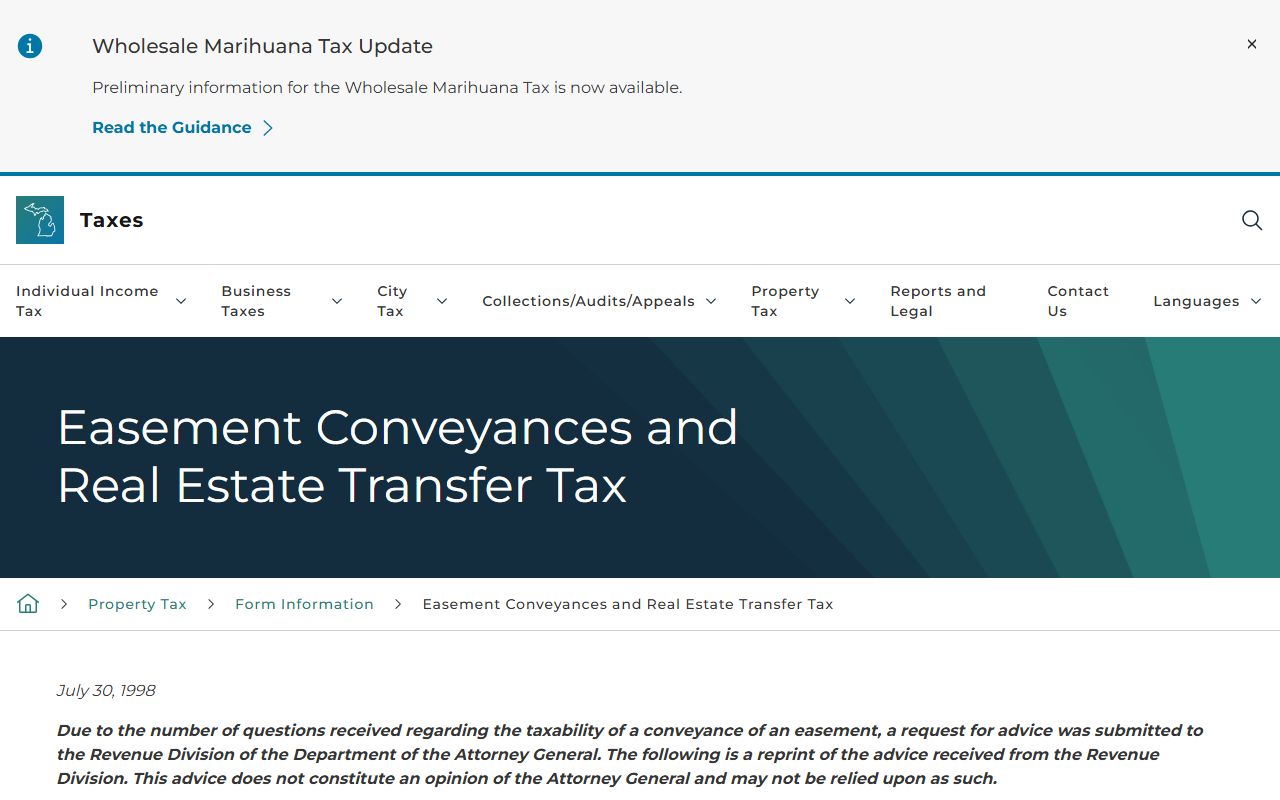
Review the Treasury's guidance on easement transfers if your property transaction involves a right-of-way or other easement, or speak with a real estate attorney familiar with Michigan law.
Common Deed Types in Shiawassee County
The most common documents recorded at the Shiawassee County Register of Deeds are warranty deeds and quitclaim deeds. A warranty deed includes a guarantee from the seller that the title is free of defects or claims. A quitclaim deed transfers the grantor's interest in the property without any such guarantee.
Other recorded instruments include mortgages, land contracts, mortgage discharges, assignments of mortgage, easements, and judgment liens. Land contracts appear fairly often in Shiawassee County, particularly for rural and agricultural properties where buyers and sellers sometimes handle financing without a bank. Under a land contract, the seller holds legal title until the purchase price is fully paid, at which point a deed is issued and recorded.
If you paid off a mortgage and the lender has not recorded a discharge, contact the lender and follow up until it is done. An open mortgage of record clouds your title and can block a future sale or refinance. The Register of Deeds office can confirm whether a discharge is on file for any given loan.
Nearby Counties
Shiawassee County borders several other Michigan counties, each with its own Register of Deeds office for local property records.