
Gratiot County Deed Records
Gratiot County deed records are kept by the Register of Deeds in Ithaca, covering all property transfers, mortgages, liens, easements, and other land documents filed in this central Michigan county. The office records over 200 different document types and maintains historical records going back to the mid-1800s. Staff can help you search by name or document type, and passport applications are also accepted at this location.
Gratiot County Deed Records
Gratiot County Register of Deeds Office
The Register of Deeds is at 214 E. Center St., P.O. Box 5, Ithaca, MI 48847. Office hours are Monday through Friday, 8:00 AM to 5:00 PM. Reach the office by phone at 989-875-5217 or by email at mmerchant@gratiotmi.com. The county website at gratiotmi.com has additional details on services, fees, and recording requirements.
The Gratiot County Register of Deeds accepts over 200 types of documents. Beyond the common deed and mortgage filings, this includes releases, assignments, easements, plats, and many other instruments related to real property. The office also accepts passport applications, so you can take care of multiple tasks in one visit if needed.
Historical deed records in Gratiot County go back to the mid-1800s. For older properties, especially agricultural land, the chain of title may span many generations. Staff can assist with older record searches, though some of the earliest documents may require working with physical ledger books or microfilm.
The Gratiot County Register of Deeds page on the county website shows the office location, contact details, and a list of the services available to property owners and title professionals.
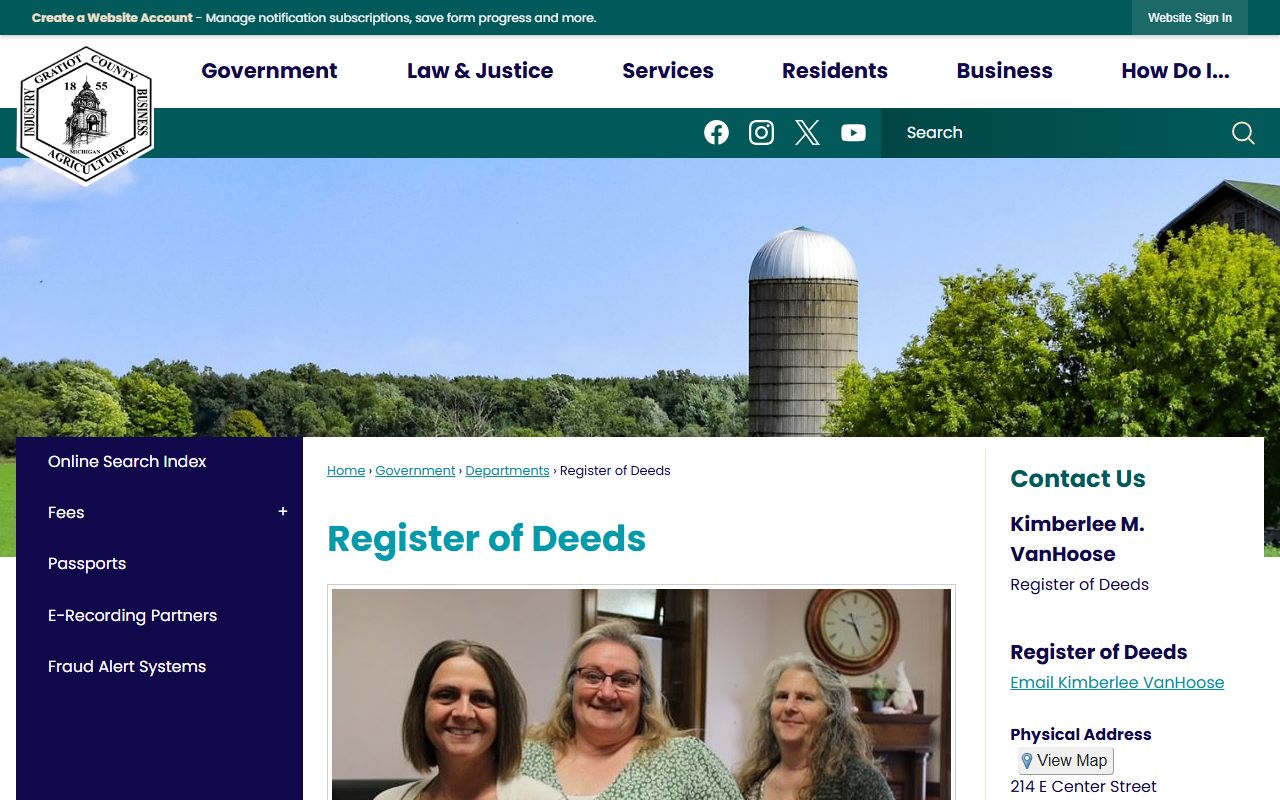
The office page links to recording requirements and provides contact information for both the Register of Deeds and related county departments that handle property taxes and assessments.
Recording Fees in Gratiot County
The flat recording fee is $30 per document under MCL 600.2657. This applies regardless of how many pages the document contains. The fee covers deeds, mortgages, releases, liens, and all other recorded instruments. This rate has been in effect statewide since October 1, 2016.
Copies are $1.00 per page. If you need a certified copy, add $5.00 for the certification. Certified copies are often required for legal matters or lender requirements. Request copies in person or by mail. For mail requests, provide the liber and page number or the recording date and party names. Include payment and a return envelope.
Call 989-875-5217 or email mmerchant@gratiotmi.com to confirm exact amounts and current processing times before sending a mail request. Staff can help you determine the right document details to include with your request.
Transfer Tax in Gratiot County
Michigan's real estate transfer tax consists of a state portion and a county portion. The state charges $3.75 per $500 of value under MCL 207.521. Gratiot County charges $0.55 per $500 under MCL 207.501. The combined total is $8.60 per $1,000 of the sale price.
The seller pays the transfer tax in most transactions. A valuation affidavit must be filed with any deed conveying property for value. This form declares the actual sale price and is required for the Register of Deeds to accept the deed. Without the affidavit, the deed will not be recorded.
Certain transfers are exempt from the tax. These include transfers between spouses, certain transfers between close relatives, and transfers involving governmental bodies. If your transaction qualifies, mark the exemption on the deed and include the correct affidavit. A title company or attorney can confirm whether an exemption applies before you go to record.
Document Formatting Under Michigan Law
All documents submitted for recording in Gratiot County must follow the standards in MCL 565.201. The Register of Deeds will return any document that does not meet these formatting requirements.
The first page must have a 2.5-inch blank top margin. All other margins must be at least 0.5 inches. Text must be at least 10-point font. The first page must include: document type, names of all grantors and grantees, full legal description of the property, mailing address for tax statements, and the name of the document preparer.
If a document is returned for formatting errors, you will need to fix and resubmit it. This can delay closings and create extra costs. Check all formatting requirements before the document is signed and notarized. Better to catch issues before signing than after.
The Gratiot County government website connects property owners to the Register of Deeds, the county equalization office, the treasurer, and other departments that handle land-related records and services.
Through the county site you can also reach the assessor for each township to file the required Property Transfer Affidavit after a deed is recorded.
E-Recording in Gratiot County
Gratiot County accepts electronically recorded documents through approved vendors. E-recording lets title companies, lenders, and attorneys submit instruments digitally, often getting them back in the record within one business day. The authority for e-recording comes from MCL 565.841, Michigan's Uniform Real Property Electronic Recording Act.
Approved e-recording vendors include Simplifile (1-800-460-5657), ePN, CSC, and Indecomm. You must set up an account with one of these vendors before submitting electronically. Each vendor charges its own service fee on top of the county recording fee. Once set up, e-recording is typically the fastest and most reliable way to get a document into the public record.
For those who submit documents less frequently, in-person or mail submissions are always an option. The office at 214 E. Center St., Ithaca, accepts documents during regular business hours. Mail submissions should be sent with payment and return postage. Allow extra time for processing when submitting by mail.
Common Deed Types in Gratiot County
Warranty deeds and quitclaim deeds are the most common instruments recorded in Gratiot County. A warranty deed carries a full guarantee from the seller that the title is clear of undisclosed claims. A quitclaim deed transfers only whatever interest the grantor holds, without any such guarantee.
Mortgages and mortgage discharges are also frequently recorded. When a loan is paid off, the lender must record a discharge to clear the lien from the title. If a discharge is missing, the title remains encumbered. Future buyers and lenders will require the issue to be resolved before a sale or refinance can proceed.
Land contracts, easements, and liens round out the most common recorded document types. Gratiot County has a large agricultural land base, so easements for drainage, utilities, and farm access are commonly filed. Each of these instruments must be recorded to be enforceable against future owners who buy without knowledge of the existing agreement. Michigan's race-notice recording rule means recording promptly after signing protects your rights.
Property Transfer Affidavit
After a deed is recorded in Gratiot County, the buyer must file a Property Transfer Affidavit with the local assessor within 45 days. This step is required under Michigan law and applies to all transfers of taxable property.
The affidavit notifies the assessor that a sale occurred and triggers a review of the property's taxable value. In Michigan, taxable value is capped while a property stays with the same owner. A transfer lifts that cap, and the assessor will re-set the taxable value for the following year. Filing on time ensures the tax records are updated correctly.
Late filing results in a penalty. Submit the affidavit to the assessor for the township, city, or village where the property sits, not to the Register of Deeds. Ask the assessor's office for the correct form and any local instructions for submission.
Nearby Counties
Gratiot County is in central Michigan and borders several other counties, each with its own Register of Deeds office for property records.