
Search Dearborn Deed Records
Deed records for Dearborn, Michigan are filed with the Wayne County Register of Deeds in Detroit, which maintains all recorded property instruments for every city and township within Wayne County. Warranty deeds, quitclaim deeds, land contracts, mortgages, easements, and lien releases for Dearborn properties are all indexed and retrievable through the county office. This page explains how to access those records, what to expect at the county level, and how the City of Dearborn's own assessing and permitting offices can fill in the gaps that deed records alone do not cover.
Dearborn Deed Records
Wayne County Register of Deeds
The Wayne County Register of Deeds is located at 400 Monroe St., 5th Floor, Detroit, MI 48226, and can be reached at 313-224-5857. The office website is at waynecounty.com/departments/register-of-deeds. This is the single office responsible for recording and indexing all real property instruments for Dearborn and every other community in Wayne County.
Wayne County's office maintains two primary divisions. The Real Property Division handles deed recordings, mortgage instruments, liens, easements, and related documents. The Personal Property Division deals with fixtures and business property filings. For Dearborn property research you will almost always work with the Real Property Division.
The office offers a Property Fraud Alert program that notifies enrolled property owners whenever a new document is recorded against their address. This free service helps detect fraudulent deed transfers before they cause serious harm. Dearborn homeowners can sign up through the Wayne County Register of Deeds website.
E-recording is available through services like Simplifile, ePN, CSC, and Indecomm. Title companies and law firms that regularly record in Wayne County use these platforms to cut turnaround time. The Wayne County Land Records search tool allows online index searches by party name, document type, and date range.
Recording Fees and Transfer Tax
Michigan charges a flat $30 recording fee for most real property documents under MCL 600.2657. This fee applies whether you submit in person, by mail, or electronically. Certified copies of recorded documents cost $5 each. Plain paper copies are $1 per page.
Transfer tax in Michigan totals $8.60 per $1,000 of the property's sale price. This combines the state real estate transfer tax and the county transfer tax. In most transactions the seller pays the transfer tax at closing. Certain transfers are exempt, including deeds between spouses, transfers to a revocable trust, and deeds given in lieu of foreclosure under specific conditions. Any deed claiming an exemption must include a written statement on the face of the document or attached as an exhibit. Without that statement, the register of deeds will collect the full tax amount at the time of recording.
The Michigan Uniform Real Property Electronic Recording Act under MCL 565.841 gives electronically recorded documents the same legal force as paper originals. Wayne County accepts e-recorded documents and processes them the same way as in-person submissions.
Michigan's Race-Notice Recording System
Michigan is a race-notice state. That means when two parties claim ownership of the same property, the one who records first generally wins, provided they had no actual notice of the competing claim at the time of purchase. For Dearborn buyers, this means recording a deed promptly after closing is critical. A deed that sits unrecorded leaves ownership vulnerable to a later buyer or lender who records before you do.
Deed formatting rules are set out in MCL 565.201. Requirements include minimum margin sizes, legible text, and the grantor's notarized signature. The grantee's name and current mailing address must appear on the document. A deed that does not meet formatting standards may be returned or assessed a non-conforming document fee, so it pays to review requirements before submitting.
City of Dearborn Assessing Department
Below is a look at the Dearborn city website, which provides links to assessing, property records, and other municipal services relevant to property research.
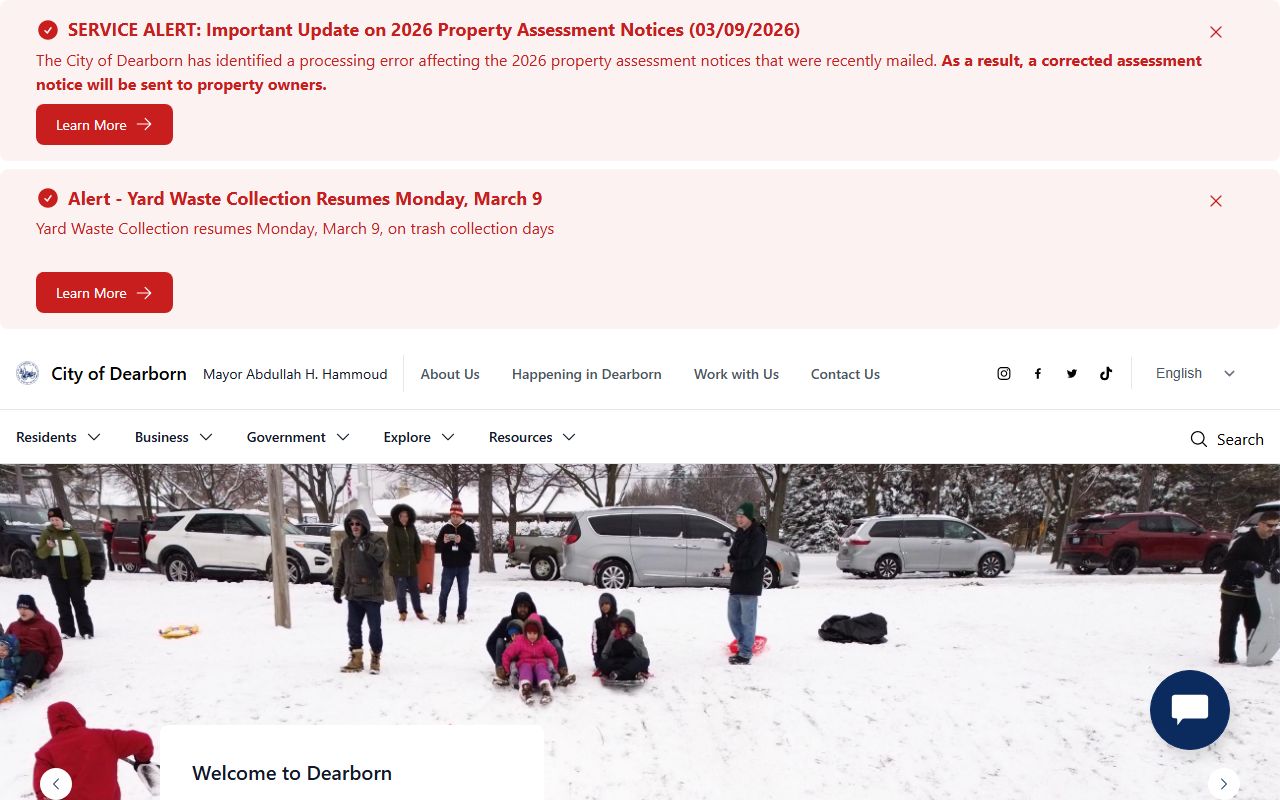
The city's home page connects residents to the assessing department and other offices that maintain records alongside those held by the county.
The City of Dearborn Assessing Department at dearborn.gov/departments/assessing maintains property records for every parcel within city limits. The assessing office handles Principal Residence Exemption applications, Property Transfer Affidavit processing, and Assessment Appeals. These records complement the deed instruments held at Wayne County.
When you buy property in Dearborn, you must file a Property Transfer Affidavit with the local assessor within 45 days of the transfer. This filing tells the assessor to update ownership and uncap the taxable value. Missing the 45-day deadline results in a penalty. The affidavit is available from the assessing office or through the city's website.
In early 2026, the City of Dearborn identified a processing error in property assessments. Corrected assessment notices were mailed to affected property owners. If you received a corrected notice and have questions about your assessment, contact the assessing department directly before the appeal deadline.
Searching Dearborn Deed Records Online and In Person
The Wayne County Land Records search tool is accessible through the Register of Deeds website. You can search the index by grantor name, grantee name, document type, and date range. The online system covers a large portion of recorded instruments, though some older records may require an in-person visit to access on microfilm or in bound volumes.
For in-person research, the Register of Deeds office at 400 Monroe St., 5th Floor is open during regular business hours. Public terminals allow free index searches. Staff can assist with locating book-and-page references for older instruments. Bring a list of prior owners or the parcel's permanent identification number to make the search more efficient.
Mail requests are also accepted. Send a written request with as much identifying information as possible, such as the document number, grantor name, or parcel number, along with a check for the applicable copy fee and a self-addressed stamped envelope. Call 313-224-5857 before mailing to confirm the current procedure.
Here is a view of the Michigan Treasury's guidance on deed-related tax topics, which helps explain the transfer tax and change-of-ownership rules that apply to Dearborn transactions.
Understanding how ownership changes are reported to the state helps buyers avoid assessment surprises after closing.
Liens, Easements, and Other Recorded Instruments
A deed search alone does not reveal all encumbrances on a property. A complete title search covers all recorded instruments, including mortgages, home equity lines, mechanic's liens, federal tax liens, judgment liens, easements, and restrictive covenants. All of these are indexed at the Wayne County Register of Deeds and searchable by the owner's name or the parcel number.
Easements that run with the land are especially important in Dearborn, where utility corridors and shared driveways are common in older neighborhoods. A deed may convey full ownership while an easement recorded years earlier grants a neighbor or utility company the right to cross the parcel. These do not show up on the deed itself but appear as separate instruments in the index.
Below is a view of Michigan Treasury information on easement and conveyance tax rules, which provides context for how certain transfers are treated under state tax law.
Knowing which conveyances are taxable and which qualify for exemption can affect how a deed is prepared before recording.
Delinquent Taxes and Their Effect on Title
Delinquent property taxes in Michigan are a first-priority lien on real property. If a prior owner failed to pay taxes, those unpaid amounts can survive a sale and become the new owner's liability. The Wayne County Treasurer maintains delinquent tax records, and any thorough title search includes a tax lien check.
Properties that remain delinquent for more than two years are subject to foreclosure by the county under Michigan's General Property Tax Act. The Wayne County Land Bank manages properties that go through this process. Buyers of foreclosed properties should verify all back taxes have been settled before closing.
The Michigan Treasury publishes delinquent tax information resources that explain the foreclosure timeline and redemption rights.
Reviewing this information before purchasing a Dearborn property can prevent unexpected tax liability from appearing after the deed is recorded.
Nearby Cities
These nearby Michigan cities also have deed records pages covering their county offices and local property resources.